Lymph Nodes Return to Previous

Help Imaginis-
Please take a moment to answer a brief survey. Your anonymous answers will help us develop www.imaginis.com better by understanding the needs of those who use the site.

Click here to complete our survey.

This section is intended to serve as an introduction to lymph nodes and the lymphatic system.  Because breast cancer often spreads first to the axillary (underarm) lymph nodes from the breast, determining whether the lymph nodes contain cancer is an essential part of the breast cancer diagnostic process.  The status of the lymph nodes helps physicians stage breast cancer, and in turn, determine treatment

Main Menu:

The Lymphatic System

The lymphatic system is an essential part of the immune system, which helps the body fight infections or cancers.  The lymphatic system consists of a network of vessels that drain tissue fluid (lymph) into lymph nodes, larger fluid-containing lymph ducts, and specialized organs involved in the immune system.  The lymph nodes and organs act as a type of “filter,” removing invading organisms or abnormal cells from the lymph fluid and “processing” them in a way that allows the body to fight these harmful agents.  Lymph is a clear whitish/yellowish fluid that contains white blood cells (lymphocytes), proteins, and some red blood cells.
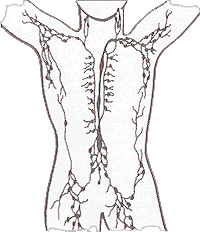
The lymphatic system.
Courtesy of NIH/NCI.

The bean-shaped lymph nodes of the lymphatic system are connected by vessels.  Lymph nodes are usually present in clusters in the armpits, on either side of the neck, and in the groin.   The lymph nodes filter lymph fluid and trap foreign materials.  Any fluid absorbed by the lymphatic system passes through at least one lymph node before it returns to circulation. 

The lymph nodes contain lymphocytes (white blood cells) which help destroy foreign bacteria or other harmful cells.  The lymph nodes may become enlarged or swollen when they fight an infection since they must produce additional white blood cells. The lymph nodes may feel tender or inflamed as they are actively fighting a foreign body.  Sometimes, the lymphatic vessels will become visible as thin red lines along a limb as the result of an infection (known as lymphangitis).  Lymph nodes may also swell from the formation of an abscess (closed pocket filled with pus) in the nodes or if they contain cancer cells. 

The Importance of Lymph Nodes in Staging Breast Cancer

Whether the lymph nodes contain cancer cells is an important factor when staging breast cancer, determining treatment, and predicting survival.  Though breast cancer has the potential to spread to other regions of the body first, it most commonly spreads first to the axillary (underarm) lymph nodes.  This is known as regional spread.  From there, the breast cancer can metastasize (spread) systematically to other areas of the body (such as the bone, liver, lung, or brain).
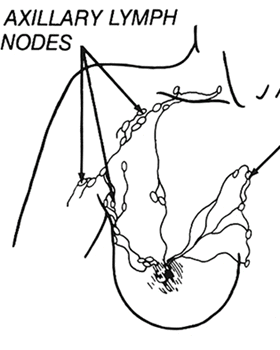
Courtesy NIH/NCI

If a woman is diagnosed with invasive breast cancer (cancer that has invaded past the wall of the breast duct or lobule and into surrounding breast tissue), it is necessary to examine the axillary lymph nodes to determine whether they contain cancer. 

Non-Invasive Breast Cancer Invasive Breast Cancer
Cancer cells that are confined to the ducts and do not invade surrounding fatty and connective tissues of the breast.  Ductal carcinoma in situ (DCIS) is the most common form of non-invasive breast cancer (90%).  Lobular carcinoma in situ (LCIS) is less common and considered a marker for increased breast cancer risk. Cancer cells that break through the duct and lobular wall and invade the surrounding fatty and connective tissues of the breast.  Cancer can be invasive without being metastatic (spreading) to the lymph nodes or other organs.

Determining whether the lymph nodes are free of cancer or not is an essential part of the breast cancer staging process and will help determine treatment and prognosis.  Tumor size and the extent to which breast cancer has metastasized (spread) to other regions of the body is also examined.

Staging Breast Cancer

Stage Tumor Size Lymph Node Involvement Metastasis (Spread)

I
II
III
IV

Less than 2 cm
Between 2-5 cm
More than 5 cm
Not applicable

No
No or in same side of breast
Yes, on same side of breast
Not applicable

No
No
No
Yes

The standard way to examine the lymph nodes is to perform an axillary node dissection. This procedure is often done during the same operation as a lumpectomy or mastectomy and involves removing 10 to 30 lymph nodes for pathological examination under a microscope.  The most common side effect of an axillary node dissection is lymphedema (chronic swelling) of the arm, which may affect up to 10% of patients.  Lymphedema occurs when the normal process of draining lymph from the arm is disrupted or blocked, causing fluid to build up in the arm.

Another surgical option called a sentinel node biopsy is now being used on select breast cancer patients to determine whether breast cancer is present in the lymph nodes.  A sentinel node biopsy involves removing only one to three sentinel lymph nodes (the first nodes in the lymphatic chain).

Studies continue to show that removing fewer lymph nodes may decrease the chance of developing lymphedema, though research on sentinel node biopsy is ongoing.  The degree to which sentinel node biopsy is effective in determining whether the lymph nodes contain cancer has been shown in research to be directly related to the experience of the surgeon who is performing the procedure.  If the sentinel node(s) is found to be cancerous upon removal, a complete axillary node dissection is usually performed.

Enlarged Lymph Nodes

The axillary (underarm) lymph nodes may become enlarged or swollen any time they produce additional white blood cells to ward off an infection.  These infections are often benign (non-cancerous).  For example, lymph nodes may swell from the formation of an abscess (closed pocket filled with pus) in the nodes.  However, lymph nodes may also swell if they contain cancer cells. 

Unfortunately, there is no perfect way of determining whether a lymph node is enlarged because it contains cancerous cells or if it is enlarged due to other, non-cancerous causes unless a biopsy is performed.  However, there can be some indications from examination that a lymph node is more likely to be benign.  For example, if a lymph node is less than one centimeter in diameter and soft, rubbery and tender, it is more likely to have swollen due to a benign cause, such as recently shaving under the arm, using a new deodorant, having a manicure, or slightly injuring the skin on the side of surgery (called the ipsilateral side).

Because of a higher risk of lymph node infection and inflammation, surgeons usually recommend that a patient avoid having blood drawn, blood pressure measurements taken, or perform unprotected work with the hand/arm on the side of surgery since these activities have been shown to increase the chances of lymphedema (chronic swelling) of the arm.

Many physicians feel that in a patient who has been diagnosed with breast cancer, it is usually wise to be cautious and biopsy any enlarged lymph nodes if the swollen node persists for beyond a month or two since it may contain cancerous cells. It is important for patient and physicians to work out a plan regarding how long a lymph node should persist before it must be removed.  In some instances, the enlarged node may be sampled by an ultrasound-guided needle biopsy. However, there may be a higher risk of missing cancer cells if a needle biopsy is performed rather than surgically removing the entire node. Click here to learn more about breast biopsy.

Exercising After Mastectomy and Lymph Node Removal

It is important that a patient ask her physician when it is safe to begin exercising and using the surgery-side arm again after a mastectomy.  While there are no contraindications to performing any number of exercises after full recovery from mastectomy, there are certain precautions that should be taken by any person who has undergone a mastectomy, especially those who have had accompanying lymph node dissection.

Any minor injury to the skin on the side of the mastectomy may become infected more easily than an injury on the other arm.  This is because the lymphatics have been disrupted and lymph nodes have been removed, leaving the arm more vulnerable to invading organisms such as bacteria. The lymphatics normally serve to drain fluids from the limb and the lymph nodes act, in some sense, as a filter, removing harmful substances from the lymph fluid.

Up to 20% of women who have undergone mastectomy and axillary lymph node dissection experience some edema (swelling) in the arm and report a higher incidence of irritation to minor skin trauma for this reason. Click here for more information on lymph nodes and breast health.

In addition, there may be a higher chance of axillary vein thrombosis (a clot in the deep vein in the armpit) in women who have undergone surgery in that area; especially if a more complete axillary dissection with the removal of 30 or more lymph nodes is performed. This is because the lymph nodes are normally located near blood vessels, and (unavoidable) scarring at or near the axillary vein may result from surgery. This scarring may tether, kink, or narrow the blood vessel and make it more susceptible to further injury.

While an increased incidence of deep vein thrombosis has not been reported in the medical literature after axillary surgery, it has been, in rare cases, associated with strenuous upper body exercise, since overdeveloped musculature may affect nearby nerves, veins, and arteries (thoracic outlet syndrome). Therefore, many physicians recommend tempering upper extremity exercise after surgery with periods of rest and keeping the arm elevated above the level of the heart for a few hours, to avoid undue swelling.  Mastectomy patients should be careful not to exercise too intensely in order to avoid preventable injury.

On a positive note, regular use of the muscles after mastectomy will keep joints limber, stretch and soften scar tissue, help recruit (open up) new lymphatics, and promote blood flow and actually help reduce clot formation. These benefits generally outweigh the risks of a careful exercise program after mastectomy.

Additional Resources and References

Updated: September 12, 2007

Return to Breast Health Main Menu

This Article Can Be Found At:

Click Here to Recommend This Article To A Friend

Home | About Us | Free Newsletter | News | Bookstore | Return to Previous


Imaginis.com subscribes to the HONcode principles of the Health on the Net Foundation.

Copyright © 1997-2008 Imaginis Corporation. All rights reserved. Imaginis® is a registered service mark of Imaginis Corporation, a health services company. All other trademarks and copyrights are property of their respective owners. Note: Use of this online service is subject to the disclaimer and the terms and conditions contained herein. Information found within the Imaginis.com website or in other sites linked to from Imaginis.com is provided for educational purposes only and is not intended to be used as a substitute for diagnosis and treatment by a medical doctor. Imaginis does not endorse and has no responsibility for the content of any other sites listed on Imaginis.com, and provides links and references merely as a convenience to its users. Seek immediate medical attention if your condition is urgent.