


- Types of Mastectomy
- Axillary Node Dissection
- Sentinel Lymph Node Biopsy
- Choosing Mastectomy as Breast Cancer Treatment
- Mastectomy and Breast Reconstruction
- Before Surgery
- The Mastectomy Procedure
- After Surgery
- Phantom Breast Pain
- Exercising After Mastectomy and Lymph Node Removal
- Recurrence of Breast Cancer
- Additional Resources and References
Mastectomy is the surgical removal of a breast. Surgery is presently the most common treatment for breast cancer. Following mastectomy, immediate or delayed breast reconstruction is possible in many instances.
There are several different types of surgical procedures used to treat breast cancer. Depending on the location or surgeon who performs the procedure, different terms may be used.
Surgical procedures for breast cancer include:
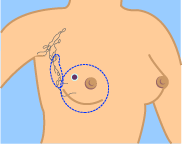
- Simple or total mastectomy: removal of the breast, with its skin and nipple, but no lymph nodes. In some cases, a separate sentinel node biopsy is performed to remove only the first one to three axillary (armpit) lymph nodes.
- Modified radical mastectomy: removal of the entire breast, nipple/areolar region, and often the axillary lymph nodes. This is the most common form of mastectomy performed today.*
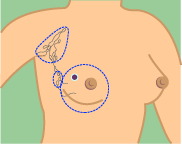
- Radical mastectomy: removal of the entire breast, nipple/areolar region, the pectoral (chest) major and minor muscles, and lymph nodes. This procedure is rarely performed today.*
- Quandrantectomy: removal of a quarter of the breast, including the skin and breast fascia (connective tissues). The surgeon may also perform a separate procedure to remove some or all of the axillary (armpit) lymph nodes, either an axillary node dissection or a sentinel node biopsy.
- Partial or segmental mastectomy: removal of a portion of the breast tissue and a margin of normal breast tissue. This procedure usually involves removing less tissue than a quandrantectomy but more than a lumpectomy or wide excision.
- Lumpectomy or wide excision: removal of the breast cancer tumor and a surrounding margin of normal breast tissue.
- Excisional biopsy also the removal of the breast tumor and a surrounding margin of normal breast tissue. Sometimes further surgery is not needed if an excisional biopsy successfully removes the entire breast cancer tumor. This is most likely to occur if the breast tumor is very small. An excisional biopsy may be performed with "needle" or "wire" localization.
*In the past, radical mastectomy was the frequently performed on women with breast cancer. However, experts have found that modified radical mastectomy is equally effective in most cases, and therefore, it has become the most common type procedure for removing the entire breast.
 |
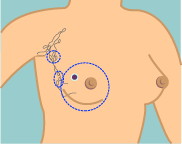 |
| Radical Mastectomy. | Modified Radical Mastectomy. |
 |
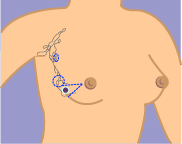 |
| Simple (total) Mastectomy. | Partial Mastectomy |
|
| |
Axillary node dissection, the surgical removal of the axillary (armpit) lymph nodes, is usually performed on patients with invasive cancers. A radical mastectomy, modified radical mastectomy, or lumpectomy operation often includes axillary node dissection (this involves a separate incision for lumpectomy patients). After surgery, the axillary lymph nodes are examined under a microscope to determine whether the cancer has spread past the breast and to evaluate treatment options.
The most common side effect of axillary node dissection is lymphedema: chronic swelling of the arm. Approximately 10% to 20% of patients typically experience lymphedema when axillary node dissection is combined with radiation therapy. Patients are encouraged to report any tightness or swelling of the arm to their physicians as soon as symptoms occur to prevent possible long-term suffering. Other side effects of axillary node dissection include temporary to permanent limitations of arm and shoulder movement and numbness in the upper-arm skin.
Side effects of axillary node dissection:
- lymphedema (swelling of the arm)
- limitations of arm/shoulder movement
- numbness of upper-arm skin
Sentinel lymph node biopsy is a procedure that involves removing only one to three sentinel lymph nodes (the first nodes in the lymphatic chain). To perform sentinel node biopsy, a radioactive tracer and/or blue dye is injected into a region of a tumor. The dye is then carried to the sentinel node (the lymph node most likely to be cancerous if the disease has spread from its original origin). If the surgeon determines that the sentinel node contains cancer, more lymph nodes are removed and examined. Surgeons detect the sentinel lymph node by either spotting the blue dye or by measuring a node�s radioactivity with a Geiger counter. If the removed sentinel node is cancer-free, additional lymph node surgery may be avoided. Research has shown that sentinel lymph node biopsy may safely eliminate the need to remove many lymph nodes and reduce the chances of lymphedema (chronic arm swelling). However, the procedure may not be appropriate for all patients. Click here to learn more about sentinel node biopsy.
