


- Who Should Receive Screening Mammography?
- How Accurate is Screening Mammography?
- Comparing Different Breast Exams
Screening mammography is a low-dose x-ray examination of the breast that is performed on women with no complaints or symptoms of breast cancer (asymptomatic). The goal of screening mammography is to detect breast cancer when it is still too small to be felt by a physician or the patient. Research has shown that the early detection of small breast cancers by screening mammography greatly improves a woman's chances for successful treatment. For example, if breast cancer is caught and treated while it is still confined to the breast ducts (a type called ductal carcinoma in situ; DCIS), the cure rate is close to 100%.
Mammographic screening is key to the early detection of breast cancerThe National Cancer Institute recommends that women begin receiving screening mammograms every one to two years at 40 years of age and every year once they reach 50 years of age. Since the number of breast cancer diagnoses rises significantly when women reach their forties, annual screening mammography can help detect breast cancers at an early stage, when treatment is most likely to be successful.
In addition, women younger than 40 who are at high risk of developing breast cancer (i.e., they have a strong family history of breast cancer or test positive from BRCA gene mutations), should ask their physicians about beginning annual screening mammograms earlier than age 40, as early as age 25 in some cases.
Women in their 40s should get mammograms every one to two years. Beginning at age 50, mammography should be performed every year.
Screening mammography involves taking x-rays from two views from each breast, typically from above (cranial-caudal view, CC) and from an oblique or angled view (mediolateral-oblique, MLO). The procedure is discussed in detail in the Mammography and How it is Performed section. If women have questions about mammography during the procedure, they should feel free to ask the mammography technologist. If women have questions about their mammogram report or the radiologist’s letter to the woman about their mammogram, they should direct those questions to the radiologist.
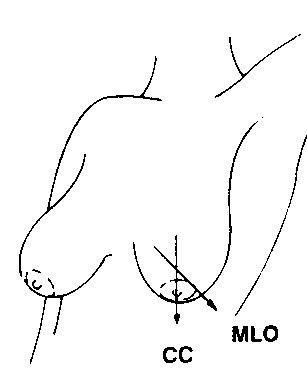 |
For screening mammography each breast is imaged separately, typically from above (cranial-caudal view, CC) and from an oblique or angled view (mediolateral-oblique, MLO). |
Mammography is currently the only exam approved by the U.S. Food and Drug Administration (FDA) to screen for breast cancer in women who do not show any signs or symptoms of the disease. Mammography can detected approximately 85% of breast cancers. If a screening mammography indicates an abnormality, women will most likely be recommended for further breast imaging (i.e., with spot view mammography, ultrasound or other imaging tests). If further imaging confirms or reveals an abnormality, the woman may be referred for biopsy to determine whether she has breast cancer.
While screening mammography can detect most breast cancers, it can miss up to 15% of cancers. These cancers may not be visible on a mammogram film. If a physician detects a breast lump with physical examination but the mammography does not reveal any abnormality, he or she will mostly likely recommend other additional breast imaging (such as ultrasound) to further investigate the lump.
Breast cancer may not be visible on a screening mammogram if:
- The cancer is very small
- The cancer is in an area that is not easily imaged with mammography (such as in the axilla; the underarm region)
- The cancer is obscured by other shadows
While mammography can occasionally miss breast cancers, it can also detect cancer several years before a lump can be felt. Therefore, it is important for women 40 years of age and older to get a mammogram each year and have current mammograms compared with previous films to determine whether cancer is beginning to grow.
Clinical studies in the U.S., Sweden, and the Netherlands have suggested that deaths from breast cancer could be cut by between 36% and 44% if mammographic screening were performed annually on all women.
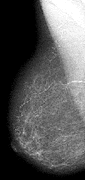 |
Mediolateral oblique (MLO) view mammogram showing the pectoral muscle, breast, nipple and breast ducts |
| Percent of American Women Who Have Had a Mammogram Within Past 2 Years | |
| All
Women Over 40 White, Non-Hispanic Women Over 40 Black, Non-Hispanic Women Over 40 Hispanic Women Over 40 Women Over 40 Below Poverty Level Women Over 40 Above Poverty Level |
66.9% 68% 66% 60.2% 50.5% 69.3% |
