|
The discovery of a breast lumpwhether by chance, during a routine breast self-exam, or during a clinical
breast examcan be stressful for a woman. Because a lump can be a symptom of
breast cancer, all persistent breast lumps should be evaluated by a physician. However,
the majority of breast lumps (approximately 80%) are due to non-cancerous
causes.
Main Menu:
What Should a Woman Do If She Finds a Breast Lump?
First, it is important for all women to practice monthly breast-self
exams beginning at age 20. These self-exams allow women to become familiar with how
their breasts look and feel so they can more readily detect any changes that may occur.
Many women naturally have some lumpiness and asymmetry (differences between the right and
left breast). The key to the breast self-exam is to learn to find changes in the breast(s)
that persist over time. If a new lump is found and does not disappear after the menstrual
cycle, then it should be reported to a physician for clinical evaluation.
 |
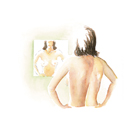
All persistent breast lumps should be evaluated by a physician. Practicing monthly
breast self-exams helps women get to know their breasts and more easily detect changes. |
Click here to
learn more about breast self-exam.
What Signs Suggest a Lump is Likely to Be Cancerous?
It is not possible for a woman or a physician to know for certain whether a breast lump
indicates breast cancer until imaging exams (such as mammography and ultrasound) and/or biopsy are performed. A breast biopsy involves taking a sample of
breast tissue and examining it under a microscope to determine whether it contains cancer
cells. However, there are certain characteristics associated with lumps that can suggest
whether they are more likely to be cancer or benign (non-cancerous).
Signs that suggest a lump is more likely to be cancerous:
- The lump is firm and hard
- The lump is not discrete; it is not easily distinguishable
- The lump is fixed in the breast; it does not move
- There is only one lump
- There is not an identical lump in the opposite breast
- The skin of breast is dimpled
- The lump is accompanied by bloody nipple discharge
Signs that suggest a lump is less likely to be cancerous:
- The lump is soft
- The lump is discrete; it is easily distinguishable
- The lump moves in the breast
- There are multiple breast lumps
- There is an identical lump in the opposite breast
- The lump disappears after the menstrual cycle
While the above signs can help suggest whether a lump is more likely or less likely to
be cancerous, having one or more of these characteristics does not guarantee or
eliminate the possibility of having breast cancer. These characteristics merely
provide clues for the physician when evaluating a lump. Some breast cancers can have
characteristics found in the "less likely to be cancerous" category. Therefore,
all persistent breast lumps need to be presented to a physician.
Fibrocystic breasts: Fibrocystic breast
condition is a common, non-cancerous condition that affects more than 50% of women at
some point in their lives. In fact, the condition is so common that many physicians
refrain from using the term "fibrocystic" and simply tell their patients that
their breasts are lumpier than average but are still normal.
The most common signs of fibrocystic breasts include: lumpiness, tenderness, cysts,
areas of thickening, fibrosis, and breast pain. Having
fibrocystic breasts, in and of itself, is not a risk factor for breast cancer. However,
fibrocystic breast condition can sometimes make it more difficult to detect a hidden
breast cancer with standard examination and imaging techniques. Therefore, it is important
that women with fibrocystic breasts practice monthly breast self-exams, receive regular
clinical breast exams, and have yearly screening mammograms
(the latter beginning at age 40).
Symptoms of Fibrocystic Breasts |
- cysts (fluid-filled sacs)
- fibrosis (scar-like connective tissue)
- lumpiness
- areas of thickening
- tenderness
- pain
|
The degree to which women experience symptoms of fibrocystic breast
condition varies considerably. Some women with fibrocystic breasts have only mild breast
pain and may not be able to feel any breast lumps when performing breast self-exams. Other
women with fibrocystic breasts may experience more severe breast pain or tenderness and
may feel multiple lumps in their breasts. Most fibrocystic breast lumps are found in the
upper, outer quadrant of the breasts (near the armpit), although these lumps can occur
anywhere in the breasts. Fibrocystic breast lumps tend to be smooth, rounded, and mobile
(not attached to other breast tissue), though some fibrocystic tissue may have a
thickened, irregular feel. The lumps or irregularities associated with fibrocystic breasts
are often tender to touch and may increase or decrease in size during the menstrual cycle.
Click
here to learn more about fibrocystic breasts.
How Are Breast Lumps Evaluated By Physicians?
Whether a breast lump is first detected by a physician during a clinical breast exam or
by the woman herself, the process of evaluation usually begins with a detailed patient
history. The physician will ask the patient specific questions about the lump and her
medical history to help identify the cause of the lump. Sample questions may include:
- How long have you had the lump?
- Does the lump change in size with your menstrual cycle?
- How long has it been since your last menstrual period?
- Have you recently been pregnant or are you breast-feeding?
- Have you experienced discharge from the nipple?
- Do you use hormone replacement therapy?
- Have you experienced any recent trauma to the breast?
- Have you had any previous breast biopsies? If yes, what were the
diagnoses?
- Do you have a history of cancer?
- Do you have a history of other medical conditions?
- Have you had a mammogram or other breast imaging test
before?
These questions can provide important information as to what is causing the lump. For
example, a woman who has recently been pregnant and who is breast-feeding may have a
galactocele (milk-filled cyst). A woman who is taking hormone replacement therapy (HRT)
may have more nodules in her breast due to the therapy. Trauma to the breast may cause a
hematoma (a blood-filled packet), fat necrosis (swelling of fatty breast tissue), or a ruptured cyst
(fluid-filled packet).
Learning the patients family and personal medical history can also be helpful. A
family history of breast cancer can increase a womans chances of developing breast
cancer herself. A personal history of non-cancerous conditions such as atypical hyperplasia (an abnormal increase in breast cells)
or lobular carcinoma in situ (LCIS) can also increase the risk of
breast cancer.
Once a thorough patient history is taken, the physician will perform a thorough clinical breast exam to investigate the lump and other
areas of the breast and axilla (armpit). In addition to feeling for breast masses, the
physician will check for any skin dimpling, nipple retraction, or other visual changes.
The clinical breast exam typically lasts several minutes and the patient will usually need
to raise her arms, place her hands on her hips and exert pressure, and lie down during the
exam so the breasts can be examined from different angles.
After the clinical breast exam, the evaluation of a breast lump will differ depending
on the womans age, history, and characteristics of the lump. The following
descriptions provide information on how women in different age groups are typically
evaluated:
- Women age 30 or older: A diagnostic mammogram is
usually ordered. A diagnostic mammogram differs from the routine screening
mammogram in that it involves additional x-ray views from different angles and/or
special magnification. A diagnostic mammogram is used instead of a screening mammogram
when a breast abnormality is present. Depending on the results of the mammogram,
additional breast imaging (such as ultrasound) may be
ordered. In many cases, further breast imaging will be ordered even if a mammogram does
not show a suspicious abnormality. This is because a small percentage of breast cancers
can be missed with mammography. Depending on the results of the mammogram and additional
imaging tests, a breast biopsy may be performed. A biopsy involves
removing a sample of breast tissue and examining it under a microscope to determine
whether cancer cells are present. Sometimes, a biopsy (or fine
needle aspirationsampling of a few breast cells) will be performed even if
breast imaging tests are normal. This usually happens when the physician suspects that the
breast lump is suspicious regardless of the results of the imaging tests.
- Women under age 30: In this group of women, a mammogram may or may not be the first
test ordered. This is because mammography is not always beneficial in younger women who
tend to have dense breast tissue which can mask breast cancer and other abnormalities on a
mammogram film. In some cases, ultrasound or other tests may be performed. However,
mammography can still be beneficial in some women younger than 30. If the breast imaging
tests reveal a suspicious abnormality, a biopsy may be ordered to examine a sample of
breast tissue. As with women over age 30, a biopsy (or fine needle
aspirationsampling a few breast cells) may be performed even if breast imaging tests
are normal. Again, this usually happens when the physician suspects that the breast lump
is suspicious regardless of the results of the imaging tests.
In approximately 80% of cases, breast lumps are benign (non-cancerous). Benign
conditions that can cause breast lumps include:
- Fibrocystic breasts
- Cysts
- Fibroadenomas
- Papillomas
- Phyllodes tumors (usually benign)
- Galactoceles
- Granular cell tumors
- Duct ectasia
- Fat necrosis
Click here
to learn more about these benign conditions.
If a biopsy reveals breast cancer, then the woman and her cancer
team will discuss treatment options. Treatment options include surgery (lumpectomy or mastectomy), radiation, chemotherapy, and/or
other drug therapies, such as tamoxifen.
Practicing monthly breast self exams, receiving regular clinical breast exams, and yearly
screening mammograms (the latter beginning at age 40) can help detect breast cancer early
when the chances of successful treatment and survival are the greatest.
Click here
to learn more about treating breast cancer.
Breast Lumps During Pregnancy
Breast cancer during pregnancy can be difficult to diagnose
because the breasts naturally undergo several changes. During pregnancy, the breasts
increase in size and become more tender, especially during the first half of pregnancy.
The most rapid period of breast growth is during the first eight weeks of pregnancy. As
the pregnancy progresses, the breasts become firmer and more nodular to prepare for lactation (breast-feeding). It is very important for women to
continue to perform monthly breast self-exams during pregnancy and
receive monthly physician-performed clinical breast exams
so as not to delay the possible diagnosis of breast cancer.
As in non-pregnant women, the majority of breast lumps found during pregnancy are
benign (non-cancerous). However, because a lump can signal breast cancer, all persistent
lumps should be evaluated by a physician. Approximately one in 3,000 (0.03%) to one in 10,000 (0.01%) women are
diagnosed with breast cancer during pregnancy. Breast cancer itself does not appear to
harm a fetus.
If a lump is detected during pregnancy, an ultrasound exam
and/or mammogram will typically be performed. Ultrasound is
excellent at distinguishing cysts (packets of fluid) and is routinely used for fetal
imaging because it does not harm the fetus. Mammography is also considered safe for
pregnant women and the fetus because it uses a very low dose of radiation. In many cases, a biopsy will be performed if a suspicious breast lump is
detected in a pregnant woman. A biopsy confirms or denies the presence of breast cancer.
Non-cancerous conditions that are common during pregnancy include:
- Cysts (collections of fluid)
- Galactoceles (milk-filled cysts)
- Fibroadenomas (tumors; existing ones may enlarge during pregnancy)
If breast cancer is detected during pregnancy, it is not necessary to terminate the
pregnancy. Treatment options should be discussed with the patients cancer team.
Surgery, such as lumpectomy and mastectomy,
can be performed safely during pregnancy. Radiation, chemotherapy, and drug therapies (such as tamoxifen) are usually delayed until after childbirth.
Click here
to learn more about pregnancy and breast cancer.
Additional Resources and References
Updated: May 4, 2008
Click here to
learn how to perform breast self-exam
Return to the Breast
Health Main Menu |