


- Clinical Breast Examination (CBE)
- Breast Changes and Warning Signs To Watch For With Breast Self-Exam:
Notice: Revised breast cancer screening guidelines issued in November 2009.
Early detection of breast cancer can lead to greater likelihood of cure. The American Cancer Society recommends the following guidelines for the detection of breast cancer in women who are asymptomatic (show no symptoms of breast cancer):
- Women 20-39 should have a physical examination of the breast (CBE or clinical breast exam) at least every three years, performed by health care professional such as a physician, physician assistant, nurse or nurse practitioner. CBE may often be received in the same appointment as a Pap smear. Women 20-39 should also perform monthly BSE.
- Women 40 and older should have a physical examination of the breast (CBE or clinical breast exam) every year, performed by a health care professional, such as a physician, physician assistant, nurse or nurse practitioner. CBE can often be performed in the same visit as a mammogram. Monthly BSE should also be performed.
- Women 40 years of age should receive a screening mammogram every year. The National Cancer Institute recommends mammography every one to two years for women between 40-50 years of age. Beginning at age 50, screening mammography should be performed every year.
In 2008, the American Cancer Society revised its guidelines to no longer recommend monthly breast self exams. This decision was made after several studies revealed that the exams do not increase the chances that women will survive breast cancer. Despite the change in position, the American Cancer Society and other organizations suggest that self exams can be performed to help detect changes in the breasts to call to a physician's attention. Women who perform self exams should consult a healthcare professional to determine how to correctly perform the exam. If women learn to perform BSE correctly, they can help detect changes and bring them promptly to a medical professional. Finding a breast cancer tumor when it is smaller improves the chances of saving a breast by avoiding a mastectomy, and may reduce the need for chemotherapy. Detailed information on breast self exam.
Women with a high risk of breast cancer and/or family history of breast cancer are encouraged to consult their doctor or other trained medical professional about receiving annual screening mammograms starting between the ages of 30 and 40. Woman at a very high risk of breast cancer (such as those tested positive for the BRCA1 and BRCA2 breast cancer genes) should speak with their physician about beginning annual mammograms as early as age 25.
A clinical breast examination (CBE) is a physical examination of your breasts by a trained medical or health professional, such as a physician, nurse practitioner, nurse, or physician’s assistant. CBE includes inspection (looking) and palpation (feeling) of the entire breast/chest area including the lymph node areas above and below the collarbone and under each arm. Women should discuss breast-self examination techniques and personal findings with the healthcare professional performing their CBE. Women should also use the CBE session as an opportunity to learn how to correctly perform breast self-exam.
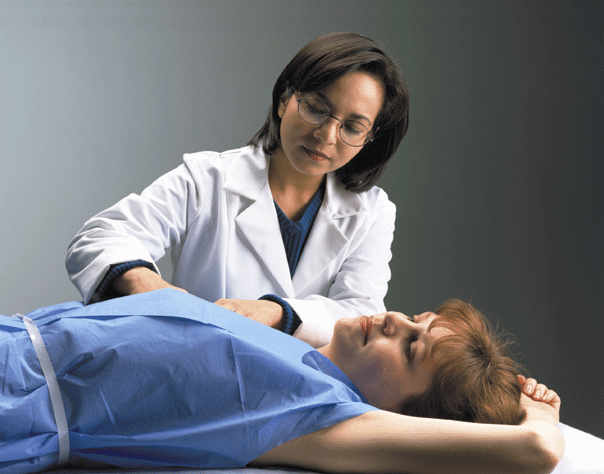
For the CBE examination, the patient undresses from the waist up. Using the pads of the fingers, the examiner will gently palpate (feel) each breast. Special attention will be given to the shape and texture of the breasts, location of any lumps, and whether such lumps are attached to the skin or to deeper tissues. The armpits and areas under both arms will also be examined.
A small percentage of breast cancers are not detected by mammography but can be felt during a clinical breast examination. Therefore it is important that a woman have both her mammogram and clinical breast exam done in the same month.
The earliest sign of breast cancer is usually an abnormality that shows up on an annual mammogram before a woman or her health care provider can feel it. The National Cancer Institute estimates that mammography can often detect very small cancers up to two years before it can be discovered by physical exam.
