


Staging is the process physicians use to assess the size and location of a patient’s cancer. Identifying the cancer stage is one of the most important factors in selecting treatment options.
The FIGO (International Federation of Gynecology and Obstetrics) system is used to stage cervical cancer. The FIGO system involves assigning a numerical stage (0 through IV) to a patient’s cancer based on physical examination and other diagnostic exams, such as cystoscopy or proctoscopy.
The stage of a cancer describes its size and the extent to which it has spread. The staging system ranges from stage 0 (early stage) to stage IV (late stage).
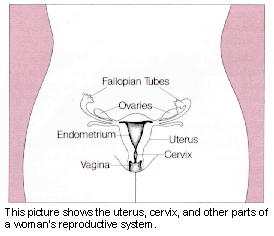
Stage 0 or "in situ:" The term "in situ" literally means "in place." Stage 0 describes cancer that has only been found in the layer of cells lining the cervix. The cancer has not invaded the deeper tissues of the cervix. Treatment options are the same as those used for pre-cancerous conditions and include cauterization, cone biopsy, cryosurgery, or laser surgery. A simple hysterectomy may be performed if the woman does not want to have children in the future. Stage 0 cancers can be effectively treated, but patients should be closely monitored by physicians for any possible recurrence.
Stage I: This stage describes cancer that has spread from the lining of the cervix into the deeper connective tissue of the cervix. Stage I cancer is still confined to the uterus.
Stage IA: This is the earliest form of stage I cancer. Only a small amount of cancer is visible upon microscopic examination. The treatment for stage IA cancer is simple hysterectomy. However, if the cancer more than 3 millimeters (approximately 1/8 inch) or has invaded the blood vessels or lymph vessels, then a radical hysterectomy may be needed. Radiation therapy may be used after surgery if the cancer cells extend to the edges of the organs that were removed. Recent clinical trials show that combined radiation and chemotherapy with cisplatin (brand name, Platinol) and other drugs is more effective than radiation alone.
Stage IA1: The area of invasion is less than 3 millimeters (approximately 1/8 inch) deep and less than 7 millimeters (approximately 1/3 inch) wide.
Stage IA2: The area of invasion is between 3 mm (millimeters) and 5 mm (approximately 1/5 inch) deep, and less than 7 mm (approximately 1/3 inch) wide.
