


In most instances, pre-cancerous or cancerous cells of the cervix are first detected with a Pap smear. All women should receive yearly Pap smears to help screen for cervical cancer beginning at age 21. Some physicians will not perform a Pap smear each year if a woman has had three negative Pap smears in the course of three years. However, a yearly pelvic exam should be continued even if Pap smears are not given each year.
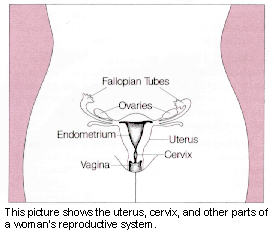
If Pap smear results are abnormal, the patient’s physician may choose between a number of options based on the patient’s history and individual situation. These options include:
- Repeat Pap smear within four to six months.
- Colposcopy: The cervix is viewed through a colposcope (an instrument with a magnifying lenses) to check for abnormalities.
- Cervical biopsy: A portion of tissue from the cervix may be removed for further examination and to confirm if cancer is present.
- Cone biopsy: An elaborate cervical biopsy, a cone biopsy involves removing a cone-shaped region of tissue high on the cervical (that would not be seen with a colposcopy).
A cone biopsy may also be performed as a treatment if a cancer is small enough to be completely removed during biopsy. There are two main methods used to perform cone biopsy. The LEEP (also called LLETZ) method, short for loop electrosurgical excision procedure, removes the tissue by using a wire that is heated by an electrical current. Patients are given local anesthesia and the procedure can be performed quickly in a physician's office. Another method of cone biopsy involves using a surgical scalpel or laser to remove the tissue. This procedure typically requires general anesthesia and may be performed in a hospital or outpatient facility. However, an overnight hospital stay is usually not required.
