|
Menopause is the time in a womans life when she stops menstruating. Natural
menopause is genetically pre-determined and typically occurs between the ages of 48 and
52. However, some women will go through menopause at an earlier or later age. Menopause is
a normal biological event that all women experience. Once a woman reaches menopause, she
can no longer bear children.
Main Menu:
Overview
According to the North American Menopause Society, approximately 41.75 million American
women were over age 50 in 2000, and approximately 31.2 million of those women were over 55
years (compared with 28.7 million in 1990). By 2020, an estimated 45.9 million women in
the United States will be over age 55. Because of the increased life expectancy over the
last several decades, it is estimated that most women go on to live one-third to one-half
of their lives after they reach menopause.
Menopause is considered premature if it occurs before age 35. Premature menopause may
occur for several reasons, including premature ovarian failure (POF), or from secondary
changes, such as the surgical removal of both ovaries (oophorectomy), certain types of
cancer treatment (such as chemotherapy or pelvic radiation), mumps, and certain autoimmune disorders such as
lupus or rheumatoid arthritis. Also, women who smoke tend to go through menopause at an
earlier-than-average age.
Before menstruation stops completely at menopause, most women will go through
pre-menopause and peri-menopause. During pre-menopause, menstrual periods (menses) begin
to become irregular. During peri-menopause, menstrual periods often become highly
irregular and women may experience symptoms of menopause, such as hot flashes, vaginal
dryness, or sleep disturbances. Peri-menopause occurs a few years before a woman reaches
menopause. Once a woman reaches menopause, menstruation will stop forever unless she takes
hormone replacement therapy.
In addition to short-term effects such as hot flashes, the decrease in levels of
hormones that occur during menopause can increase the risk of osteoporosis
and heart disease. Therefore, it is important that women
maintain a healthy lifestyle and talk to their physicians about ways to protect themselves
from future health problems.
The Female Reproductive System
The female reproductive system is made up of both external and internal organs.
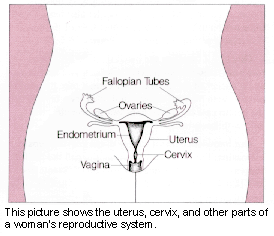
Vulva: The term vulva refers to the external parts of the female genitalia. The
upper portion of the vulva is covered with pubic hair in mature females. The lower portion
of the vulva consists of the labia majora (outer lips), which are two folds of fatty
tissue covered with skin. Inside the labia majora are the labia minora (inner lips),
another two folds of tissue. The labia minora protect the opening of the urethra (urine
canal) and the entrance to the vagina. Above the urethra, the labia minora join to form
the tip of the clitoris. The clitoris plays a key role in female sexual arousal.
Vagina: The vagina is the canal that leads from the uterus to the outside of the
body. It serves as a passageway for menstrual discharge and as the birth canal. In young
girls, the opening of the vagina is covered by a thin membrane called the hymen. As a
woman begins to increase physical activity, use tampons, or engage in sexual intercourse,
the hymen is gradually stretched. The vagina tends to be dry in girls before puberty and
in women after menopause.
Cervix: The cervix is the lower portion of the uterus that connects the uterus
to the vagina. The opening of the cervix remains small except during labor when it expands
to allow the baby to pass from the uterus to the vagina. Click
here to learn more about cervical cancer.
Uterus: The uterus is a pear-shaped muscular sac that houses the fetus during
pregnancy. During each menstrual cycle, the lining of the uterus (endometrium) thickens to
prepare for possible pregnancy. If a woman does not become pregnant during this time, the
endometrium is shed and exits the body through the vagina each month during menstruation. Menstruation ends at menopause.
Fallopian tubes: The Fallopian tubes are attached to the uterus and extend toward
the ovaries. At the ends of each tube are fringe-like structures called fimbriae that wrap
around each ovary. These fimbriae help guide the reproductive eggs (ova) that are released
by the ovaries each month into the Fallopian tubes in pre-menopausal women. When an egg
enter one of the Fallopian tubes, a series of contractions force the egg down toward the
uterus. While an egg is traveling from the ovaries to the uterus through one of the
Fallopian tubes, it may be fertilized by sperm released during sexual intercourse.
Ovaries: The ovaries are located on both sides of uterus. In addition to
producing the hormones estrogen and progesterone, the ovaries also produce mature
reproductive eggs (ova) that are released each month during ovulation in pre-menopausal
women. If an egg becomes fertilized by sperm while it travels from the ovaries to the
uterus through one of the Fallopian tubes, then it implants itself in the uterus where it
will grow and evolve into a mature baby over the next nine months. If the egg is not
fertilized by sperm, then it breaks down along with the uterine lining and is discarded
during menstruation. Near menopause, the follicles in the ovaries become less responsive
to the follicle-stimulating hormone (FSH), which is responsible for preparing the egg for
fertilization. When a woman reaches menopause, her ovaries reduce their production of
estrogen and progesterone which usually results in irregular periods and other symptoms
such as hot flashes, vaginal changes, sleep disturbances, etc.
Normal Female Reproductive Development |
| 8 weeks in utero |
Around 8 weeks after
conception, it is possible to distinguish a female fetus from a male fetus. The female
reproductive organs develop before birth. |
| Age 6 |
As early as age 6,
there are noticeable physical differences between girls and boys. In girls, the buttocks
tend to be rounder, the shoulders are narrower, and the hips are wider. |
| Age 12 |
Age 12 is the average
age of menarche (the first menstrual period). At this age, a girl is about halfway through
puberty, the time when the breasts grow, the hips widen, and pubic hair appears. The onset
of menstruation marks the beginning of the reproductive years. The menstrual periods may
be irregular for the first 1-2 years. |
| Age 18 |
By age 18, most young
women have reached their adult height, weight, and shape. Menstrual periods become more
regular in most women by this time. |
| Ages 44-48 |
As a woman
approaches menopause, her body produces less estrogen and progesterone. This depletion in
hormone levels can cause irregular menstrual cycles, hot flashes, vaginal dryness, and
other menopausal symptoms. The length of this phase (called perimenopause) and the
associated symptoms varies significantly from woman to woman. |
| Age 50 |
Between the ages of
48 and 52, most women reach menopause and are no longer able to bear children. After
menopause, the vagina may grow smaller and less elastic, and the uterus and ovaries
decrease in size. Typically, menopausal symptoms, such as hot flashes, decrease a few
years after menopause. |
Menopause Terminology
| Menopause |
The final menstrual
period, usually recognized 12 months or more after it occurs. |
| Pre-menopause |
One to two years
before menopause when menstrual periods become irregular; or, a term used to describe all
of the reproductive years. |
| Peri-menopause |
The years just prior
to menopause when the menstrual periods become highly irregular. |
| Menopausal
transition |
See
peri-menopause. |
| Natural
menopause |
The permanent
cessation of menstruation that occurs without the influence of surgery or other actions
that may induce menopause. |
| Premature
menopause |
Permanent cessation
of menstruation that occurs significantly earlier than the general population (before age
35). |
| Induced
menopause |
Permanent cessation
of menstruation secondary to surgical removal of the ovaries or therapy that destroys the
function of the ovaries (i.e., pelvic radiation or sometimes chemotherapy). |
| Surgical
menopause |
Menopause induced by
the surgical removal of both ovaries (oophorectomy). |
| Chemotherapy-induced
menopause |
Permanent cessation
of menstruation directly caused by the administration of chemotherapy to treat cancer. In
some women, chemotherapy may induce the temporary cessation of menstrual periods, with
menses returning some time after the completion of chemotherapy (see temporary menopause). |
| Radiation-induced
menopause |
Permanent cessation
of menstruation due to radiation therapy; usually only caused by direct radiation to the
pelvic region. |
| Temporary
menopause |
Non-permanent
cessation of menstruation; may be caused by chemotherapy, pelvic radiation, drug therapy,
etc. |
| Post-menopause |
The time period
beginning after the last menstrual period. |
| Climacteric |
The transition from
the reproductive to non-reproductive years; typically begins with peri-menopause and lasts
a few years after menopause. |
Menopausal Symptoms
The symptoms of menopause vary significantly from woman to woman. Some women only
experience mild menopausal symptoms while others have severe discomfort. The most common
symptoms that signal that a woman is beginning the transition to menopause are irregular
menstrual periods, hot flashes, and vaginal dryness.
Most women experience changes in their menstrual periods before they reach menopause.
These changes may include longer or shorter menstrual cycles or the absence of
menstruation (amenorrhea) for periods of time. On average, women experience changes in
menstrual periods approximately two years before they reach menopause, although the time
may be longer or shorter depending on the individual. It is important for women to report
these changes to their physicians since, at times, irregular menstrual cycles can signal
other health problems.
Hot flashes are a common symptom of menopause. Hot flashes may be accompanied by
sweating, flushing, or heart palpitations. Hot flashes occur when estrogen is blocked in
the hypothalamus, the part of the brain that controls the bodys thermostat. It is
estimated that nearly 80% of menopausal women experience hot flashes. Hot flashes
typically last up to two years after the final menstrual period.
During peri-menopause (the time period immediately before a woman reaches menopause),
changes also occur in the vagina and urinary tract. Vaginal tissue becomes thinner, dryer,
and less elastic, which may cause discomfort or pain during sexual intercourse. Urinary
tract tissue also becomes less elastic, which may cause a release of urine during
laughter, coughing, sneezing, or exercise. Many women also find that urinary tract
infections occur more frequently during this time. Other menopausal symptoms may include
mood changes, insomnia (sleep deprivation), depression, or anxiety. Hormone replacement
therapy (HRT) can relieve many of these symptoms.
Menopausal Symptoms |
- Irregular menstrual periods
- Hot flashes
- Vaginal dryness
- Mood changes
- Insomnia (sleep deprivation)
- Depression
- Anxiety
|
Diagnosing Menopause
Before menopause, the female body produces the hormones estrogen and progesterone in
the ovaries. Estrogen works to regulate a womans monthly menstrual cycle and
secondary sexual characteristics (such as breast development and function), and also
prepares the body for fertilization and reproduction. Progesterone is released each month
during menstruation to prepare the uterus for possible pregnancy and to prepare the
breasts for lactation (milk production). As a woman reaches menopause, typically around 50
years old, her body produces less and less estrogen and progesterone.
This loss of estrogen and progesterone usually results in irregular periods and other
symptoms such as hot flashes, vaginal changes, sleep disturbances, etc. At this time, a
womans physician will usually test her follicle stimulating hormone (FSH) level. FSH
is a hormone that is secreted by the bodys pituitary gland to stimulate growth of
ova (female reproductive eggs). As the ovaries produce less estrogen, the pituitary gland
increases production of FSH to try to stimulate the ovaries into producing more estrogen.
While FSH levels can help determine a womans stage of menopause, FSH levels do
tend to fluctuate from month-to-month during peri-menopause. Women who take oral
contraceptive pills will have to temporarily stop taking them so that their FSH levels can
be measured accurately. In addition, as a woman nears menopause, the walls of her vagina
will become thinner and dryer. At this time, the physician may take a sample of the
vaginal wall when performing a Pap smear. However, it is also
important for a woman to keep track of her menstrual periods when they begin to become
irregular to help her physician know when she is in the pre-menopausal and peri-menopausal
stages.
Coping With Short Term Effects of Menopause
While menopausal symptoms (hot flashes, vaginal dryness, sleep disturbances, etc.) are
temporary, they are usually bothersome to most women. There are a variety of ways to treat
these symptoms, from natural remedies (such as dressing in layers to reduce the effects of
hot flashes) to taking hormone replacement therapy.
Hormone replacement therapy (HRT) is synthetic estrogen and/or progesterone (called
progestin). It is designed to "replace" a menopausal womans depleting
hormone levels. HRT helps to relieve hot flashes and other menopausal symptoms. Research
has also shown that HRT may also help prevent osteoporosis, heart disease, short-term
memory loss, depression and other diseases or conditions in post-menopausal women.
While HRT can greatly reduce menopausal symptoms and may provide protection against
other diseases and conditions, there is also conflicting evidence that supports a link
between HRT and an increased risk for breast cancer. However, current research shows the
risk to be small and that it appears to be related to the duration of treatment and the
general breast cancer risk of the patient. Further research will provide more information
on the risks of HRT. Because HRT can provide many benefits, patients and physicians should
make the decision about HRT together, based on a womans individual medical situation
and circumstances.
For women who choose not to take HRT, there are a variety of over-the-counter products
available. Some of these products contain phytoestrogens, natural chemicals that act like
a weak form of estrogen. Some research suggests that products containing phytoestrogens
(such as soy) may help alleviate menopausal symptoms, although
further research is still needed to confirm this association. Women should discuss the use
of these products with their physicians, as they may not be appropriate for all women.
Some women find that regular exercise can improve hot flashes. Calcium is also thought
to reduce the occurrence of hot flashes. The National Institute on Aging provides the
following suggestions to help improve hot flashes:
In 2001, the American College of Obstetricians and Gynecologists (ACOG) issued new practice guidelines to physicians regarding
the use of over-the-counter botanical products as alternatives to HRT in relieving menopausal symptoms. The chart below
summarizes their findings.
ACOG Summary: Botancial Products to Treat Menopausal Symptoms |
| Soy |
May be effective at
relieving menopausal symptoms for two years or less. Safe in dietary amounts. Large
amounts may be harmful for women who have or have had breast cancer or other women. |
| Black Cohosh |
May be effective at
relieving menopausal symptoms for six months or less. |
| Wild and Mexican
Yam |
Not expected to be
effective at relieving menopausal symptoms. |
| Dong Quai |
Not expected to be
effective at relieving menopausal symptoms. Potentially toxic. May increase risk for skin
cancer. |
Source: American College of Obstetricians and Gynecologists. Click here for more information.
- Dress in easily removable layers
- Drink a glass of cold water or juice at the onset of a flash
- Keep a thermos of ice water by the bed to drink when needed
- Keep an ice pack by the bed at night to use on the skin when a hot flash occurs
- Use cotton sheets, lingerie and clothing which lets the skin "breathe"
Women who experience vaginal dryness, irritation, or discharge are encouraged to ask
their physicians about using vaginal lubricants to help relieve these symptoms. In some
cases, vaginal discharge can be an indication of a more serious condition, such as
endometrial cancer (cancer of the uterine lining), and may require further investigation.
Menopause and Osteoporosis
The loss of estrogen at menopause is associated with a significantly increased risk of osteoporosis. Osteoporosis is a decrease in normal bone
mineral density. A loss of bone density causes bones to become brittle, and in turn, may
lead to more frequent fractures and other serious effects. It is estimated that one in two
women over 50 will have an osteoporosis-related fracture.
Before a woman reaches her mid-30s, her body gains more bone than it loses. Around age
35, this process balances out. However, the onset of menopause (and a decrease in
estrogen) around 50 years of age may speed up the rate of bone loss. Bone loss, known as
osteopenia, may eventually become more severe and result in osteoporosis. When this
occurs, a woman is at greater risk for bone injury and fracture, even with relatively
minor trauma.
The key to avoiding severe effects from osteoporosis and bone fractures associated with
the condition is prevention. Women may protect themselves from severe bone loss by:
Click
here for more information on osteoporosis.
Menopause and Heart Disease
When a woman reaches menopause, her risk of heart disease
increases due to a loss of estrogen. An estimated 9,000 American women under age 45 have
heart attacks each year versus 250,000 women over age 65. Researchers believe that
estrogen helps protect women against heart disease in their reproductive years and appears
to help maintain lower cholesterol levels and improve artery flexibility and
expandability. Pre-menopausal women are still at risk of heart disease, but the risk is
significantly lower than for post-menopausal women, according to researchers. When a
womans estrogen production ceases at menopause, her arteries tend to lose their
flexibility and her risk of heart disease increases significantly since no collateral
(back-up) blood supply is developed.
Because many of the other risk factors for heart disease are controllable, women can
minimize their risk of heart disease by focusing on these controllable risk factors. Many
of these risk factors can be changed with modifications to diet, exercise, or drug
therapy. Women should talk to their physicians about their risk of heart disease and how
best to minimize this risk.
Controllable risk factors for heart disease include:
- High cholesterol
- High blood pressure
- Smoking
- Obesity
- Lack of physical activity
- Stress
Click
here to learn more about heart disease.
Regular Physical Exams After Menopause
Because menopause and advancing age increase the risk for several diseases and
conditions, it is very important that women continue to receive annual physical exams once
they reach menopause.
Women 40 years of age and older should have the following specific exams every year in
addition to an overall physical exam:
Beginning at age 50, women should also have a sigmoidoscopy every three to five years
to screen for colon cancer. A sigmoidoscopy involves examining the rectum and lower
portion of the colon. Women who have a family history of cancer or other illnesses should
talk to their physicians about beginning screening exams at an earlier age. With continued
focus on their health, women can continue to lead long, productive lives for decades after
menopause.
Additional Resources and References
Updated: January 15, 2008
Return to Women's Health Main Menu |