


- Prevention of Osteoporosis
- The Importance of Calcium and Vitamin D
- Calcium Supplementation Has Been Proven to Reduce Bone Loss
- It's Never Too Late to Begin Taking Calcium Supplements
- What Causes Calcium Loss?
- Additional Resources and References
Many women do not realize they have osteoporosis until they suddenly break a bone from a minor injury. Telltale signs of osteoporosis include curvature of the spine, severe back pain, or loss of height. Osteoporosis may be prevented by maintaining a proper diet and appropriate levels of physical activity and exercise. Both men and women should insure that their calcium intake is adequate by eating milk products, and green leafy vegetables such as spinach, citrus fruits and shellfish. Calcium supplements are also widely available, and if recommended by a doctor, those supplements can help older people maintain sufficient calcium intake.
Women may help prevent osteoporosis by:
- Maintaining a balanced diet, rich in calcium
- Performing regular weight-bearing exercise or activity
- Not smoking
- Limiting alcohol intake
- Using medications such as hormone replacement therapy when appropriate
Maintaining a diet rich in calcium is one of the best ways to help prevent osteoporosis since the body stores 99% of calcium in bones and teeth (the remaining 1% is stored in the blood and soft tissue).
Optimal daily intake calcium requirements:
| Group | Intake of Calcium (mg) | |
| Infant | Birth-6 months | 400 |
| 6 months-1 year | 600 | |
| Children | 1-5 years | 800 |
| 6-10 years | 800-1,200 | |
| Adolescents & Young Adults |
11-24 years | 1,200-1,500 |
| Men | 25-65 years | 1,000 |
| Over 65 years | 1,500 | |
| Women | 25-50 years | 1,000 |
| Pregnant and nursing | 1,200-1,500 | |
| Over 50 years (postmenopausal) | 1,500 | |
| On estrogens | 1,000 | |
| Not on estrogens | 1,500 | |
| Over 65 years | 1,500 | |
Source: National Institutes of Health
Diet is the best way to obtain the necessary amount of calcium. The chart below gives some examples of calcium-fortified foods (the body may not be able to absorb all of the calcium in these foods). If a person’s diet does not provide him or her with an adequate amount of calcium, then calcium supplements may be also be used (see section below).
| Examples of Foods Rich in Calcium | ||
| Food | Serving Size | Calcium (milligrams) |
| Low fat yogurt | 1 cup | 415 |
| Milk | 1 cup | 300 |
| American cheese | 1 ounce | 175 |
| Chocolate pudding | 0.5 cups | 140 |
| Ice milk, ice cream, frozen yogurt | 0.5 cups | 90 |
| Tofu (made with calcium sulfate) | 4 ounces | 250-370 |
| Sardines (with bones) | 3 ounces | 370 |
| Salmon (with bones) | 3 ounces | 180 |
| Trout | 3.5 ounces | 218 |
| Turnip greens | 1 cup | 200 |
| Bok Choy | 1 cup | 160 |
| Broccoli | 1 cup | 136 |
| Collard greens | 1 cup | 357 |
| Vegetable lasagna | 1 slice | 450 |
| Cheese enchilada | 1 piece | 324 |
| Cheese pizza (10 inch) | 1 slice | 290 |
| Calcium-fortified orange juice | 1 cup | 300 |
| Waffle | 7 inch | 179 |
Source: FORE (Foundation for Osteoporosis Research and Education)
Vitamin D is another important nutrient in helping to prevent bone loss. Vitamin D helps the body absorb calcium and deposit it into bones. The recommended daily intake of vitamin D is 400 international units (IU). Vitamin D may be obtained from vitamin-D fortified milk and foods such as liver, fish, and egg yolks. Vitamin D supplements or a multiple vitamin that contains 400 IU of vitamin D are also good sources. Sunshine on the skin also helps the body make Vitamin D. Generally, 15 minutes of sun exposure per day is enough to maintain sufficient Vitamin D levels.
Recently researchers conducted a long-term placebo-controlled study of calcium intake and bone mineral density in 122 normal women (Reid IR et al.New England Journal of Medicine 1993; 328: 460-464.). Bone densitometry (total body, lumbar spine, and proximal femur) was completed on each woman and showed that calcium supplementation had a beneficial effect on bone loss that was consistent and statistically significant throughout the skeleton. The placebo group (those who did not take calcium) lost bone at a rate of about 1% a year at most bone sites. On average, the rate of loss of total-body bone mineral density was reduced by almost half (43%) in the group taking calcium supplements. Loss was eliminated entirely in the trunk. The only adverse effect of taking calcium supplements noted in the study was the development of a kidney stone in one patient at six months.
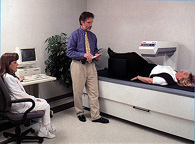
Lying comfortably, a patient is about to undergo a DEXA bone density measurement exam
A total intake of 1500 mg per day is about the average amount of calcium required to keep a postmenopausal woman in calcium balance. This intake is probably two or three times that of most adult women in the United States. Study data (Reid et al) indicate that a higher daily calcium intake (1750 mg total) may be more effective for reducing bone loss.
