


Some questions you may be asked before having MR imaging may include:
- Are you pregnant or is there a possibility that you may be pregnant?
- Are you allergic to any medication?
- Have you had any head surgery?
- Have you had heart surgery?
- What surgery, if any, have you had?
- Have you ever had joint surgery or joint replacement?
You may also be asked specific questions such as:
- Do you have any objects implanted in your body (such as an artificial hip)?
- Do you have a heart pacemaker?
- Do you have a "porta-cath" device?
- Do you have an artificial heart valve?
- Do you have an intrauterine device (IUD)?
- Do you have a neuro stimulator (Tens-unit)?
- Do you have a joint replacement?
- Do you have any metal plates, pins or screws your body?
- Do you have any surgical staples or aneurysm clips in your body?
- Do you have permanent eyeliner?
- Do you have a tattoo?
- Have you ever had a bullet wound or been hit by shrapnel?
- Have you ever worked with metal?
Note: Patients with an implanted metal device or other metal in their body that is susceptible to the MRI system's magnetic field (such as those items listed above) may not receive an MR imaging examination. If there is a possibility that a patient may have some metal or metal fragments in his or her body, a screening x-ray can help to determine if an MR exam will be possible.
Patient preparation may require that you change into a comfortable, light-weight medical gown to allow imaging free from disturbance or artifacts caused by the fabric, zippers or buttons in your clothing.
You may also be asked to remove:
- jewelry or watches
- hairpins or hair clips
- keys, coins, wallets or credit cards
- eyeglasses
- hearing aids
- removable dental work
- belts and buckles
Most MR examinations are similar and generally include the following steps:
- Patient preparation involves removing any articles of clothing or jewelry that might degrade the MR images. In some cases, the patient may be asked to wear a patient gown. Many MR examinations require the administration of a contrast agent (liquid which enhances images of the organs and/or blood vessels).
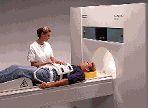
- The patient is positioned by the technologist on the specialized MR table. A special apparatus called a surface coil (a special radio antenna) is positioned around the area of interest, for example the knee, and then positioned inside the MR gantry.
- The technologist leaves the MR patient room. During the individual MR sequences that are run (usually from two to six different sequences of two to fifteen minutes each), the patient will hear a knocking sound from within the MR system. An "MR sequence" is an acquisition of data that yields a specific image orientation and a specific type of image appearance or "contrast." Depending on the system and the type of study being run, the knocking may be loud enough to require ear plugs or special head phones for the patient. During the MR examination, the technologist and patient may communicate at any time via intercom.
- After the MR examination, the technologist will ask the patient to get dressed and wait while the MR images are reviewed, either on film or a monitor.
- After the MR images are reviewed, the patient will be released from the imaging department or center. In some cases, more images will need to be taken. For more information see " What happens during a diagnostic imaging examination?"
