


Physicians have known for years that breast-feeding protects infants against health problems. The American Academy of Pediatrics says that breast-feeding may be linked to a reduction of infant ear infections, allergies, diarrhea, bacterial meningitis, and other serious illnesses. With the dramatic increase in the number of allergy sufferers in the United States and other Western countries, researchers have been investigating possible causes and methods to curb allergic tendencies. Though medical professionals do not doubt the sizable benefit breast-feeding can provide infants, new research is emerging that shows that the benefit of protecting infants against allergies by breast-feeding may be limited if the mother herself is highly allergic.
In fact, one study suggests the possibility that a key benefit of breast-feeding—the ability to protect infants against infections—may indirectly increase allergic tendencies in children. Still, physicians recommend breast-feeding to at least postpone a child’s tendency to develop allergies and protect against a host of other health problems.
- A study of 545 infants published in the January 1998 issue of the British Medical Journal showed that breast-feeding for 15 weeks reduced the risk of infant respiratory infections by 50%.
- A 17-year study of 236 children in Finland showed that food, respiratory, and eczema (skin inflammation) allergies were significantly reduced if infants were breast-fed for more than six months.
- An 11-year study of 664 children found that the benefit of breast-feeding was linked to whether or not their mothers had allergies. Prolonged breast-feeding by mothers with few or no allergies protected children from developing allergies themselves. However, children of highly allergic mothers who were breast-fed for four months or longer actually developed more allergies than children whose mothers breast-fed them for shorter periods of time (or did not breast-feed).
- A study of 480 air force cadets in Italy (published in the February 2000 issue of the British Medical Journal) showed that respiratory allergies were less common among cadets who had been exposed to infectious organisms in food and water, suggesting that the protective effects of breast-feeding and a semi-sterile Western diet may actually increase allergic tendencies by altering the pattern of normal and abnormal organisms in the intestines.*
This last study coincides with the belief some medical experts hold that removing certain foods from a child and nursing mother’s diet (such as fish, soy milk, eggs, and peanuts) may inadvertently increase the risk of allergies in children because the balance of their body’s immune-response cells becomes altered.
The immune system produces Th1 cells and Th2 cells among others. Th1 cells help ward off infections while Th2 cells set off allergic responses to harmless proteins. Research has shown that the Th1 cells tend to dominate over Th2 cells in infants who live in environments where infectious organisms thrive (such as Third World countries). These infants tend to develop few if any food allergies. However, in Western cultures where the nursing mother and infant tend to avoid certain foods, the incidence of allergies is much higher.
Other studies dispute this theory, though. Dr. Robert S. Zeiger of the Kaiser Permanente Medical Center in San Diego conducted a study which found that avoiding certain foods could benefit a child at high risk of developing allergies (as determined by family history). Dr. Zeiger found that high risk infants who were not given cow’s milk, eggs, and peanuts during infancy and whose mothers did not eat these foods while breast-feeding developed fewer food allergies than high risk infants on an unrestricted diet.
Despite contradictory studies, the majority of physicians agree that breast-feeding helps protect infants from a variety of health problems. In fact, researchers from the University of Rochester who recently conducted a study on breast-feeding and infant pacifier use say that the longer a mother breast-feeds, the better she protects her infant’s health. The study, published in the March 2000 issue of Pediatrics, followed 265 nursing mothers in New York, finding that infants who used pacifiers were breast-feed less often after the first three months than infants who did not use pacifiers.
According to the researchers, the mothers who breast-fed less often were more likely to complain about inadequate milk supplies. Though this is the first study of its kind conducted in the United States, three Brazilian studies confirm the results. The researchers suggest that mothers should try not to give their children pacifiers until breast-feeding is well established.
Approximately 62% of mothers breast-feed their children. To best protect a child’s health by breast-feeding, experts suggest that women feed their children the colostrum produced in the breast the first few days after birth. Colostrum is rich in nutrients, including a substance called a transforming growth factor (TGF-beta). TGF-beta helps promote tolerances to certain substances that could cause allergic reactions (eczema, for example). TGF-beta also helps with the formation of the infant’s intestines, promoting tolerance and reducing the likelihood of future food allergies.
Allergy experts advise women with allergies not to introduce their baby to solid foods before he or she is six months of age. At that time, foods should be introduced one at a time. According to allergy experts, women may want to also consider the following to reduce the chances their children will develop allergies:
- Do not allow smoking around a baby
- Enclose the crib mattress with an allergen-proof cover
- Do not put stuffed animals in a baby’s room
- Put an air filter in the baby’s room
- Wash the baby’s clothes and bedding with a mild, unscented laundry detergent and rinse twice
- *Source of compiled studies: The New York Times (see reference below)
- The February 29, 2000 New York Times report by Jane Brody, "Linking Allergy, Asthma and Infant Diets," is available at http://nytimes.com/library/national/science/health/022900hth-brody.asp
- The March 2, 2000 USA Today report, "Study: Hold Off on Pacifiers," is available at http://www.usatoday.com/life/health/child/nutritio/lhcnu006.asp
- The March 3, 2000 article published in Pediatrics, "The Effects of Early Pacifier
Use on Breastfeeding Duration," is available at
http://www.pediatrics.org/cgi/content/full/103/3/e33?maxtoshow=&HITS=10&hits=
10
&RESULTFORMAT=&author1=Howard,+C.&searchid=QID_NOT_SET&< br>FIRSTINDEX=&fdate=3/1/1999&tdate=3/31/1999 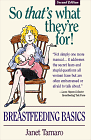 So That's What
They're For!: Breastfeeding Basics by Janet Tamaro (1998) provides extensive information
on breast-feeding in an easy-to-read, comprehensive, and humorous
format. Click
here for more information.
So That's What
They're For!: Breastfeeding Basics by Janet Tamaro (1998) provides extensive information
on breast-feeding in an easy-to-read, comprehensive, and humorous
format. Click
here for more information.
- For additional resources on breast-feeding, visit the breast-feeding section of the Imaginis.com Breast Health Bookstore at http://www.imaginis.com/bookstore/breasthealth/nursing.asp
