


- What is Ductography/Galactography and Why is it Performed?
- How is Ductography Performed?
- Is Ductography Painful?
Ductography (also called galactography or ductogalactography) is a special type of contrast enhanced mammography used for imaging the breast ducts. Ductography can aid in diagnosing the cause of an abnormal nipple discharge and is valuable in diagnosing intraductal papillomas and other conditions. Papillomas are wart-like, non-cancerous tumors with branchings or stalks that have grown inside the breast duct; they are the most common cause of nipple discharge.
Nipple discharge can be caused by non-cancerous tumors (such as papillomas) or cancer (such as ductal carcinoma in situ, DCIS). However, the majority of nipple discharges are due to benign (non-cancerous) causes. In particular, discharges that are yellow, green, blue, or black in color are usually categorized as less suspicious. For example, blue or black discharges are often associated with benign cysts. Discharges that are bloody, colorless, or clear in color are categorized as more suspicious, but further investigation usually results in a benign diagnosis. Bilateral nipple discharge (discharge occurring from both breasts) is usually benign and does not typically require investigation with ductography or other procedures. However, all persistent discharges should be reported to a physician for evaluation.
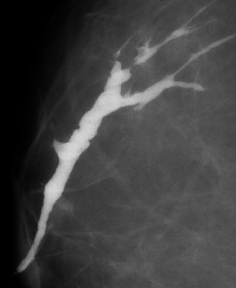
This ductogram (or galactogram) image shows the contrast filled breast duct as white. A small, dark round nodule may be seen in the left branch of the breast duct near the bifurcation (point where the duct splits into two branches).
Most women are able to undergo ductography. However, it may be more difficult to perform ductography in:
- Women who have severe allergies to the contrast media used during the procedure. (In some cases, it may be possible to perform ductography with premedication and non-ionic contrast since little contrast is actually absorbed during the procedure).
- Women who have had previous nipple surgery that has completely disconnected the nipple pores from the underlying ducts. (This may be a limited study but it may still be valuable in detecting abnormalities in the small segment of duct just beneath the nipple).
- Women with severe nipple retraction (turning inward) that would make the procedure difficult to perform. (However, the procedure may be worth attempting in select cases).
Screening mammography and diagnostic mammography differ from ductography in that they do not use contrast injection. Ductography is a specialized procedure and is only performed at select centers and hospitals by radiologists with significant experience with ductography. Many healthcare locations that perform screening or diagnostic mammography do not perform ductography.
