


Staging is the process physicians use to assess the size and location of a patient’s cancer. Identifying the cancer stage is one of the most important factors in selecting treatment options.
The FIGO (International Federation of Gynecology and Obstetrics) system is used to stage ovarian cancer. The FIGO system involves assigning a numerical stage (0 through IV) to a patient’s cancer based on the results of diagnostic tests such as laparotomy or laparascopy.
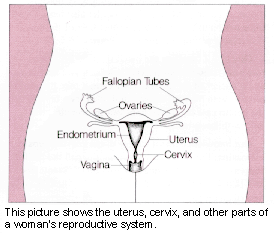
The stage of a cancer describes its size and the extent to which it has spread. The staging system ranges from Stage 0 (early stage) to Stage IV (late stage).
Stage I: This stage describes cancer that is still confined to one or both ovaries.
Stage IA: This is the earliest form of stage I cancer. Cancer is present inside one ovary. No cancer cells are present on the outside surface of the ovary or in the abdomen or pelvis.
Stage IB: With this stage, cancer is present inside both ovaries but no cancer cells are present on the outer surfaces of the ovaries. There are also no cancer cells in the abdomen or pelvis.
Stage IC: With this stage, cancer is present in either one or both of the ovaries. In addition, cancer cells may also be present on the outer surfaces of one or both ovaries; the outer wall of a cystic ovarian tumor may have ruptured; or cancer cells may have been found in tissue samples from the abdomen.
Stage II: This stage describes cancer that is present in either one or both of the ovaries and has spread to other organs within the pelvis, such as the uterus, Fallopian tubes, bladder, the sigmoid colon, or the rectum.
Stage IIA: With this stage, cancer is present in one or both of the ovaries and has spread into the uterus and/or Fallopian tubes. However, cancer cells are not present in the abdomen.
Stage IIB: With this stage, cancer is present in one or both of the ovaries and has spread to other pelvic organs, as the bladder, colon, rectum, or uterus.
Stage IIC: The cancer is in one or both ovaries, and the cancer has spread to lymph nodes and/or dposits of cancer larger than 2 cm (about 3/4 inch) across are seen in the abdomen.
Stage III: This stage describes cancer that is present in one or both of the ovaries. In addition, the cancer has spread past the pelvis to the abdominal lining and/or has spread to the nearby lymph nodes.
Stage IIIA: With this stage, the cancer is present in one or both of the ovaries, and cancer cells are also present in small amounts in parts of the abdomen.
Stage IIIB: With this stage, the cancer is present in one or both of the ovaries, and cancer cells are also present in amounts less than two centimeters (three-fourths of an inch) in parts of the abdomen.
Stage IIIC: With this stage, the cancer is present in one or both of the ovaries. In addition, the cancer has either spread to the nearby lymph nodes or cancer cells are present in amounts greater than two centimeters (three-fourths of an inch) in parts of the abdomen.
Stage IV: This is the most advanced stage of ovarian cancer. Cancer cells are present in one or both of the ovaries, and the cancer has spread (metastasized) to other organs in the body, such as the liver or lungs.
Recurrent: This describes ovarian cancer that has returned after treatment.
Updated: October 28, 2008
