|
Main Menu:
Overview
Breast reconstruction is a
surgical procedure to rebuild the contour of the breast, along with the nipple and
areola (the pigmented area surrounding the nipple) if desired. Recent advances in
reconstructive techniques have given patients more choices when it comes to breast
reconstruction, including the option to have breast reconstruction during the same
operation in which the breast is removed. Being diagnosed with breast cancer is not
usually a medical emergency; most women have a sufficient amount of time to research
treatment and reconstructive options before having to make any decisions.
Though some women are not interested in
breast reconstruction, many breast specialists support reconstructive surgery as an
important option for patients to consider. Women are encouraged to weigh both the
advantages and disadvantages of breast reconstruction with their plastic surgeons and
cancer treatment team and make an informed decision based on their own situation. Breast
reconstruction is most often an option for women who have had mastectomy
if their entire breast has been removed. Women who undergo lumpectomy
(surgical removal of a breast lump and a margin of surrounding tissue) rarely need breast
reconstruction.
The goal of breast reconstruction is to
create breast symmetry when a woman is wearing a bra. When a woman is nude, the
reconstructed breast will look different from the unaffected breast, regardless of the
type of reconstruction chosen. However, when a woman is wearing a bra, the size and shape
of the reconstructed breast should closely resemble the unaffected breast.
It is a common misconception that women
may have to wait a year or longer to begin the reconstructive progress after breast
surgery. Though breast cancer patients who receive chemotherapy after mastectomy may have
to delay reconstruction under chemotherapy is finished, the majority of women begin may
reconstruction soon after the surgery in which the breast is removed (if not during the
same operation).
Types of
Breast Reconstruction
There are two main types of breast
reconstruction available to most mastectomy patients:
- Saline breast implants
- Muscle flap reconstruction
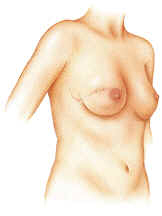
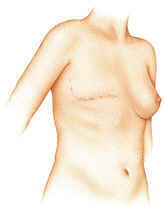
The insertion of saline
(salt-water filled) implants is usually a two-part procedure. The first implant operation
involves placing a tissue expander in the intended breast area beneath the skin and chest
muscle. The tissue expander is similar to a balloon, and the surgeon will fill the
expander with salt-water solution periodically (usually once a week). The procedure to
insert the tissue expander into the breast area typically takes about forty-five minutes.
After the skin has sufficiently stretched, the surgeon will replace the tissue expander
with a permanent saline implant, usually three to four months after the first implant
surgery. Occasionally, a woman will not need a tissue expander. If this is the case, then
the surgeon will proceed directly to permanent implant surgery. Approximately 50% of
saline implants need some type of modification or replacement after five or ten years.
The second main type of breast
reconstruction, muscle flap reconstruction, involves using a patients own tissue to
rebuild the contour of the breast. Tissue may be taken from the back, stomach, or
buttocks. Muscle flap operations leave scars both from where the tissue was taken and on
the reconstructed breast. In a free TRAM (Transverse Rectus Abdominis Muscle) flap
procedure, the surgeon transfers some abdominal skin, fat, and a small piece of muscle
under the skin to the intended breast area. The tissue from abdomen is usually enough to
create a breast shape. If not, a saline implant may also be inserted. In a back tissue
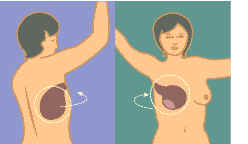
(latissimus dorsi) reconstructive flap, a surgeon transfers muscle and skin from the
patient's back to the intended breast area. This creates a pocket where an implant is
usually inserted.
Muscle flap procedures take much longer
than implant operations, lasting about four to five hours, and patients typically stay in
the hospital three to four days, compared to one day with the implant operation. Though
the recovery is slower, the breast usually looks and feels more natural to most women.
Because muscle flap reconstruction
involves the blood vessels, women who smoke or have diabetes, vascular, or connective
tissue diseases cannot typically undergo this type of breast reconstruction.
 |
Latissimus dorsi muscle flap (back tissue) reconstruction. Image courtesy of NIH/NCI.
|
Because many breast cancers involve the
nipple areolar complex, the surgeon usually removes the nipple during mastectomy. After
the breast volume has been rebuilt with a tissue expander or muscle flap procedure, the
nipple may be recreated. Most nipple recreation takes place two to six months after the
initial breast reconstruction to allow the new breast area ample time to heal. A new
nipple may be created from a skin graft from a womans inner thigh or from the areola
(the pigmented region surrounding the nipple) on her natural breast. Occasionally after a
skin graft, the skin of the newly created nipple turns white. Some surgeons prefer to
tattoo the skin graft of the new nipple to ensure that the color matches the color of the
nipple from the natural breast. See the section on peg procedures below for more
information.
Peg
Procedures
A new type of breast reconstruction
developed by Dr. Edward Knowlton, MD, promises to reduce a patients mastectomy scar.
Results of Dr. Knowltons research were published in the September 1992 issue of Contemporary
Surgery and also presented in San Diego at the annual meeting of the American Society of Plastic and
Reconstructive Surgeons. According to Dr. Knowlton, the peg procedures can
recreate both the shape and size of the breast as well as the nipple and areola (darker
pigment surrounding the nipple). In one type of peg procedure, the traditional
straight-line mastectomy scar is replaced with a circular scar that is hidden within the
border of the newly created nipple.
The newest peg procedure (called the
pectoralis peg) uses only the remaining breast skin after a mastectomy and relies on the
bodys own healing processes to create a normal-looking nipple. After the body heals
from mastectomy, new blood vessels usually grow into the remaining skin from the
pectoralis muscle on the chest wall. The pectoralis peg procedure uses this new blood
supply to provide circulation to the newly created nipple and areola. Thus, a skin graft
from another portion of the patient's body is not necessary (as it is with most muscle
flap reconstructive techniques).
The benefits of peg procedures include:
- Camouflaging scars around the
reconstructed nipple and areola
- Immediate breast reconstruction can
usually be performed in one procedure
- The breast skin envelope is preserved
- A full range of breast sizes and shapes
are possible
- Breast symmetry is usually achieved
- Effects of the procedures do not
typically change significantly over time
- The procedures can be modified for a
variety of accepted techniques including: immediate reconstruction, delayed
reconstruction, TRAM flap reconstruction, implant insertion, and repositioning of the
breast
The peg procedures are not suitable for
all women considering breast reconstruction. Click here to learn more about the peg procedures.
Finding
a Plastic Surgeon
If a woman is contemplating breast
reconstruction, she should discuss her options with a plastic surgeon. It is important to
make sure that the plastic surgeon is certified by the American Society of Plastic
Surgeons and has experience with breast reconstruction.
Women may contact the American Society
of Plastic Surgeons (ASPS) at 1-800-635-0635 to find out if their plastic surgeon is board
certified. The ASPS was formed in 1972 and provides women with a list of ASPS certified
members in the callers area. The ASPS website also allows women to search for a plastic surgeon by
name, city, state, or zip code.
Possible
Complications With Breast Reconstruction
| The most common side
effect of saline implants is capsular contracture-the scar around the implant
begins to tighten and squeezes down on the soft implant, causing the breast to feel hard. |
As with any type of surgery,
breast reconstruction has certain risks women should consider before deciding on
reconstructive surgery. The most common complication with breast implants is capsular
contracture: the scar or capsule around the implant begins to tighten and squeezes down on
the soft implant, causing the breast to feel hard. Capsular contracture may be treated
with additional surgery to remove the scar tissue. Occasionally, patients with capsular
contracture may have to have the breast implant removed and replaced with a new one.
Other rare complications from general
surgery may also occur during breast reconstruction, including: bleeding, fluid collection, excessive scar tissue, infection, and
problems with anesthesia. Women who smoke may experience a slower rate of healing or more
noticeable scars since nicotine often interferes with the bodys natural healing
process. Rarely, these complications may require additional surgery.
Note: It is not possible for women to
breast-feed from the reconstructed breast. Even with nipple reconstruction and tattooing
of the areola, the breast still lacks the proper glandular tissue and ducts necessary to
produce milk. There has been no evidence that breast reconstruction causes a recurrence of
breast cancer.
The Ban on Silicone Gel Implants
In 1992, the U.S. Food and Drug
Administration imposed a ban on the general use of silicone gel-filled breast implants.
Silicone implants may only be used in closely monitored medical trials until they are
determined to be safe for widespread use. Questions concerning the safety of silicone
implants arose after manufacturing defects and implant misuse led to silicone leakage and
rupturing in many patients. When silicone gel is free in breast tissue, it may move to
nearby tissues or to the lymph nodes. Some physicians attribute silicone leakage to
immune-related disorders and other sicknesses. Many women who experienced silicone leakage
reported:
- breast pain
- fatigue
- myalgias (muscle pain)
- arthralgias (joint pain)
- hair loss
- memory loss
There is much controversy surrounding
silicone breast implants. Many medical experts doubt silicone implants cause any
significant medical disease. Radiologists do worry about the difficulty in detecting
breast cancer in breast with implants (saline or silicone). See the section below on
breast imaging after reconstruction for more information.
Advantages
and Disadvantages to Breast Reconstruction
The majority of women diagnosed
with breast cancer will undergo some type of breast surgery as part of their treatment.
For many simple or modified radical mastectomy patients,
breast reconstruction may be possible during the same surgical procedure. However, there
are advantages and disadvantages to immediate breast reconstruction:
Advantages to immediate breast
reconstruction:
- Patients do not wake up to the
"shock" of losing a breast.
- Patients may avoid additional
reconstructive surgery.
- Many doctors agree that the best-looking
results occur when the cancer surgeon and the plastic surgeon plan the operation together.
Disadvantages to immediate breast
reconstruction:
- Patients may find it emotionally
difficult to weigh all of their breast reconstruction options while also dealing with
their recent breast cancer diagnosis and treatment alternatives.
- If surgeons find that the cancer is more
advanced than they initially thought, breast reconstruction may interfere with treatment
(such as chemotherapy or radiation
therapy).
Some doctors recommend that women who
need radiation therapy after breast surgery have delayed breast reconstruction. Though
radiation after the insertion saline implants or muscle flap procedures may potentially
distort the breasts, this is rare. Radiation therapy can usually be administered to
patients after breast reconstruction without any significant consequences.
Usually women who have breast
reconstruction may choose to have the nipple and areola (the pigmented region surrounding
the nipple) reconstructed during additional surgeries. Nipple and areola reconstruction
occurs after the breast has had time to settle after the initial reconstructive surgery.
Tissue for the nipple can be taken from the newly created breast, the opposite nipple, or
even the ear. Tissue for the areola can be taken from the upper inner thigh. To match the
other nipple and to create the areola, tattooing may be done.
The American Cancer Society suggests
breast cancer patients ask their plastic surgeons the following questions before having
breast reconstructive surgery:
- Am I a candidate for breast
reconstruction?
- When can I have reconstruction?
- What types of reconstruction are
possible for me?
- What is the average cost of each type of
reconstruction and does insurance typically cover them?
- What type of reconstruction is best for
me? Why?
- How much experience do you (plastic
surgeon) have with this
- procedure?
- What results are realistic for me?
- Will the reconstructed breast match my
remaining breast in
- size?
- How will my reconstructed breast feel to
the touch?
- Will I have any feeling in my
reconstructed breast?
- What possible complications should I
know about?
- How much discomfort will I feel?
- How long will I be in the hospital?
- Will I need blood transfusions?
- If so, can I donate my own blood?
- How long is the recovery time?
- When can I begin to exercise? Play
sports?
- Are there any patients I can speak with
who have had the same surgery?
- Will reconstruction interfere with chemotherapy?
- Will reconstruction interfere with radiation therapy?
- How long will the implant last?
- What kind of changes to the breast can I
expect over time?
- How will aging affect the reconstructed
breast?
- What happens if I gain or lose weight?
- What new reconstruction options should I
know about?(1)
Health Insurance Coverage for Breast Reconstruction
According to the American Society of
Plastic and Reconstructive Surgeons, the average surgeon fee for breast reconstruction is:
- $2841 implant alone
- $3413 for a tissue expander
- $5646 for a back flap procedure
- $7088 for a TRAM flap procedure
- $9315 for a microsurgical free flap
procedure
These fees do not include bills from
anesthesiologists, hospitals, or the cost of implants. Most health insurance companies do cover the cost
of breast reconstruction after mastectomy. In 1998, the Women's Health and Cancer Rights Act was
passed, which requires all health insurance providers who cover mastectomy procedure to also
cover the costs of breast cancer reconstruction for mastectomy patients. Under this legislation, insurance
companies who cover the cost of mastectomy must also cover the costs of the following:
- reconstruction on the post-mastectomy breast
- surgery and reconstruction on the other breast to create symmetry
- breast prostheses
- treatment of complications from mastectomy, including lymphedema (chronic swelling) of the arm
Several states also have their own laws that require health plans who cover the costs of mastectomy to also provide
the option of reconstruction. The Women's Health and Cancer Rights Act is designed to provide coverage to women whose
health plans are not required by state law to cover the costs of breast reconstruction. To view laws for each state
regarding breast reconstruction, please visit the Plastic Surgery Information Service
website at http://www.plasticsurgery.org/advocacy/brstlaws.htm.
Although the Women's Health and Cancer Rights Act was passed in 1998, there are several issues
that still need to be worked out, including questions about retroactive coverage, delayed breast
reconstruction, etc. The Department of Labor is expected to address these and other issues in the near
future. In the meantime, women who have questions about these issues should call their health
insurance provider, the Department of Labor's hotline at 1.202.219.8776, or their State Insurance Commissioner's office.
Breast
Imaging After Reconstruction
It is important for women who have
had breast reconstruction to continue receiving yearly mammography
on the normal breast. Women who have had breast reconstruction should also practice
monthly breast self-examination (BSE) and have yearly clinical breast exam. Click
here to learn more about the guidelines for early detection of breast cancer.
Many radiologists do not take screening
images of the area where the breast was removed (even if an implant or tissue flap is
present) unless there is a clinical concern (for example, a new lump is found). Imaging
breasts with implants requires a radiologist to take several special mammography views so
he or she may see both the breast tissue and the implant. For this reason, diagnostic mammography is usually performed on women after
breast reconstruction. Diagnostic mammography involves pinpointing the exact size and
location of breast abnormalities as well as imaging the surrounding breast tissue and
lymph nodes. Click here to learn more about mammography
with breast implants.
Additional
Resources and References
- The American Cancer Society
provides information on all aspects of breast reconstruction at
http://www.cancer.org/.
-
The Imaginis report, "FDA Publishes New Handbook on Breast Implants," is
available at http://www.imaginis.com/breasthealth/news/news9.13.00.asp.
-
The FDA's breast implant brochure (2004 edition) and supplemental information on breast
implants, including photographs of implant complications, is available free
of charge at http://www.fda.gov/cdrh/breastimplants/.
- American Society of Plastic Surgeons
provides information on breast reconstructive options at http://www.plasticsurgery.org/surgery/brstrec.htm
-
The Plastic Surgery Information Service website, maintained by the American Society of Plastic Surgeons
and the Plastic Surgery Educational Foundation, provides information n state laws regarding breast
reconstruction at http://www.plasticsurgery.org/
- The American Society of Plastic Surgeons
provides information on breast reconstructive option. Several detailed pictures help users
visualize mastectomy scars, balloon expanders, nipple restoration, TRAM flap surgery,
transplanted tissue, and more at http://www.plasticsurgery.org/
- Allergan, Inc., a
manufacturer of breast implants, provides consumer-oriented information on silicone gel-filled breast implants at http://www.breastimplantstoday.com/
Updated: September 12, 2007
Return to Cosmetic Main Menu |