|
Magnetic resonance breast imaging (MRI, MR) has been
approved by the U.S. Food and Drug Administration (FDA) since 1991 for use as a
supplemental tool, in addition to mammography, to help
diagnose breast cancer. Breast MRI is an excellent problem-solving technology. It is often
used to investigate breast concerns first detected with mammography, physical exam, or
other imaging exams. MRI is also excellent at imaging the augmented
breast, including both the breast implant itself and the breast tissue surrounding the
implant (abnormalities or signs of breast cancer can sometimes be obscured by the implant
on a mammogram). MRI is also useful for staging breast cancer,
determining the most appropriate treatment, and for patient follow-up after breast cancer
treatment.
In addition to its role as a diagnostic tool, researchers have been investigating whether
breast MRI may be useful in screening younger women at high risk of breast cancer. Most
women under 40 years of age do not require any breast imaging. However, the American Cancer
Society recently recommended that women at very high risk of developing breast cancer have annual
breast MRI exams in addition to annual mammograms to increase the likelihood that breast cancer
will be detected early, when the chances of survival are greatest. Because MRI is more sensitive
than mammography, it can help detect cancer that may be missed by mammography. However, because
this increased sensitivity can also lead to false positive results, which requires breast
biopsy procedures, the American Cancer Society does not recommend MRI for all women.
 |
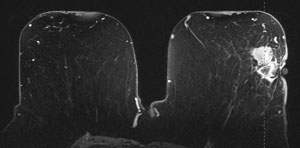
MRI image of the breast,
showing a lesion. Image
courtesy of Siemens Medical.
|
Main Menu:
How Breast MRI is Performed
Unlike mammography which uses low dose x-rays to image the breast, MRI uses
powerful magnetic fields and radio waves to create images of the breast. The MRI system is
able to switch magnetic fields and radio waves to achieve views in any plane and from any
orientation while x-ray mammography requires re-orientation of the breast and mammography
system for each view desired.
The main component of most MRI systems is a large tube-shaped or cylindrical magnet. To
begin the MRI exam, the patient is positioned on a special table inside the MRI system
opening where a magnetic field is created by the magnet. Each total MRI exam is typically
comprised of a series of 2 to 6 sequences, with each sequence lasting between 2 and 15
minutes. An "MRI sequence" is an acquisition of data that yields a specific
image orientation and a specific type of image appearance or "contrast."
 |
 |
|
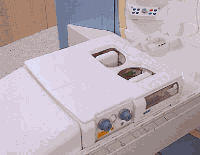
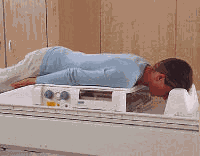
A recent advance in MRI breast imaging is the CP Breast Array Coil, which
allows for bilateral breast imaging and improved differentiation between various breast
tissue. The patient is placed directly on the table and the technologist has visual
control of breast position through a transparent window. Images courtesy of Siemens
Medical. |
During the examination, a radio signal is turned on and off, and subsequently, the
energy which is absorbed by different atoms in the body is echoed or reflected back out of
the body. These echoes are continuously measured by the MRI scanner. A digital computer
reconstructs these echoes into images of the breast. The tapping heard during the MRI exam
is created when "gradient coils" are switched on and off to measure the MRI
signal reflecting back out of the patient's body. A benefit of MRI is that it can easily
acquire direct views of the breast in almost any orientation while mammography requires
re-orientation of the breast and mammography system for each view desired. An MRI exam of
the breasts typically takes between 30 and 60 minutes.
The most useful MRI technique for breast imaging uses a contrast material called
Gadolinium DTPA, which is injected into a vein in the arm before or during the exam to
improve the quality of the images. This contrast agent helps produce stronger and clearer
images and "highlight" any abnormalities.
 |
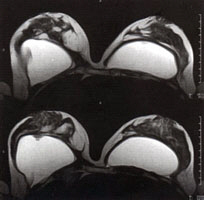
Transverse high-resolution MRI scan of breast and implants. Note the implant
twisting on the upper (left) image and the implant valve on the lower (left) image.
|
Benefits of an MRI Exam of the Breast
MRI has several potential benefits in helping to investigate breast concerns. An MRI
exam allows breast images to be taken in any plane and from any orientation. One
particular advantage of MRI is that it is highly sensitive to small abnormalities that can
sometimes be missed with other exams. For instance, a mammogram or ultrasound (sonogram) of the breast may reveal breast cancer in
one area. However, an MRI of the breast may show that the cancer is in fact multi-focal;
small tumors are present in several areas of the breast. Researchers are currently investigating whether MRI
would be helpful to routinely use on breast cancer patients to screen for cancer in the opposite
breast. Determining the extent of breast
cancer with MRI can help indicate treatment: breast conserving surgery (lumpectomy) or breast removal (mastectomy).
Mastectomy is indicated if there are multiple tumors.
MRI may also be useful in helping to determine whether breast cancer has spread into the
chest wall. If there is evidence of breast cancer in the chest wall, a patient often needs
to undergo chemotherapy before breast cancer surgery. Not knowing
whether the chest wall is involved can delay chemotherapy and cause the patient to have
both chemotherapy and radiation therapy after surgery.
Physicians sometimes use MRI to detect cancer recurrences in
women who have already been treated for breast cancer with lumpectomy.
In addition, MRI can assess whether a newly inverted nipple is evidence of a
retroareolar cancer, a tumor under the areola (the pigmented region surrounding the
nipple).
Another major benefit of MRI is that it plays a significant role in the visualization
of breast implants. MRI can often show if an implant is leaking or ruptured. MRI can also
image the breast tissue that is compressed by an implant. Implants can obscure some of the
breast tissue on conventional mammogram images, making abnormalities or sings of cancer
more difficult to see. This is because the x-rays used for mammography cannot penetrate
silicone or saline implants well enough to image the overlying or underlying breast
tissue. MRI imaging does not have this limitation. However, mammography is still the best
tool for evaluating breast tissue and for screening for breast cancer. There is currently
no routine recommendation for using MRI as a cancer screening tool in women with implants,
although it can be helpful in selected cases.
 |
Transverse fast acquisition breast MRI images at same level without contrast
(upper) and with contrast (lower). Note how the abnormality in the lower breast image on
the right is "highlighted" by the contrast (Gadolinium DTPA). |
Because MRI is very sensitive, the American Cancer Society recently recommended that
women at very high risk of developing breast cancer have annual breast MRI exams in
addition to annual mammograms to increase the likelihood that breast cancer will be detected
early. While most women under 40 years of age do not require any
breast imaging (i.e., mammography), some younger women are at high risk of breast cancer
due to a strong family history or a mutated breast cancer gene
(BRCA1 or BRCA2). However, young women tend to have dense breast tissue which can make
screening mammography less effective. This is because breast tissue density shows up as a
white region on a mammogram just as a cancer would. (As women age, their breasts become
less dense, increasing the effectiveness of screening mammography). With MRI, physicians
may be able to more easily distinguish between density and breast abnormalities.
The American Cancer Society recommends breast MRI exams for women with one of the following:
- a BRCA1 (breast cancer gene 1) or BRCA2 (breast cancer gene 2) mutation
- a first-degree relative (parent, sibling, child) with a BRCA1 or BRCA2 mutation, even if they have yet to be
tested themselves --a lifetime risk of breast cancer oft 20%-25% or greater, based on one of several accepted
risk assessment tools that consider family history and other factors -a history of radiation to the chest
between the ages of 10 and 30
- Li-Fraumeni syndrome, Cowden syndrome, or Bannayan-Riley-Ruvalcaba syndrome, or may have one of
these syndromes based on a history in a first-degree relative
Women should consult their physicians to determine their lifetime breast cancer risk.
Benefits of Breast MRI |
- Can image breast implants and ruptures
- Highly sensitive to small abnormalities
- Used effectively in dense breasts
- Can evaluate inverted nipples for evidence of cancer
- Can evaluate the extent of breast cancer
- Can help determine what type of surgery is indicated (lumpectomy or mastectomy)
- May detect breast cancer recurrences and residual tumors after lumpectomy
- Can locate primary tumor in women whose cancer has spread to axillary (armpit) lymph
nodes
- Can spot or characterize small abnormalities missed by mammography
- May be useful in screening women at high risk for breast cancer, according to recent
studies
|
Click Here to View Breast MRI Case Studies.
Limitations to an MRI Exam of the Breast
While MRI has significant promise as a supplemental tool to mammography in the diagnosis of breast cancer, there
are limitations associated with MRI. First, MRI cannot always distinguish between cancerous and non-cancerous
abnormalities, which can lead to unnecessary breast biopsies. Another drawback of breast MRI is that has
historically been unable to effectively image calcifications, tiny calcium deposits that can indicate
breast cancer. However, MRI technology is improving in this area. Still, mammography can reliably
image calcifications, which are often associated with early-stage breast cancers such as ductal
carcinoma in situ (DCIS).
Another drawback of breast MRI is
that has historically been unable to image calcifications, tiny calcium
deposits that can indicate breast cancer. Mammography, on the other hand, can
reliably image calcifications, which are often associated with early-stage breast cancers
such as ductal carcinoma in situ (DCIS).
 |
MRI image showing DCIS. Image courtesy of Siemens Medical. |
Another potential drawback of MRI is that it has been shown
to produce a moderate amount of false-positive results. In other words, the results of an
MRI sometimes show that a suspicious abnormality is present in the breast when, in fact,
cancer is not present. To some degree, all medical tests tend to lose some of their value when
used in populations where the disease is not common.
Furthermore, MRI is an expensive exam; an average MRI of the breast costs approximately
$1000 versus $100 per screening mammogram. MRI can also take longer than mammography: more
than 30 minutes in addition to the administration of the contrast versus 10 to 15 minutes
for a screening mammogram. Patients need to lie still in a prone (face down) position
during the exam to eliminate motion in the images. Though an MRI exam is not painful,
patients must tolerate any claustrophobia (fear of small spaces) they may have. A contrast
agent is also given prior to the exam to improve image quality. See the above section on How Breast MRI is Performed for more information on the contrast agent.
Finally, MRI is not nearly as widely available as mammography. However, access is increasing, and
breast MRI is the second fastest growing MR procedure in the United States. In 2004, 24% of
all facilities offering MR services offered breast MRI. According the Advisory Board, by
2010, an estimated 860,000 breast MR procedures will be performed.
Limitations of Breast MRI |
- MRI takes 30-60 minutes compared to 10-20 minutes for screening mammography
- The cost of MRI is several times the cost of mammography
- MRI requires the use of a contrast agent
- MRI patients must tolerate any claustrophobia
- MRI can be non-specific; often cannot distinguish between cancerous and non-cancerous
tumors
- Minimally invasive breast biopsy techniques need to be further developed to evaluate
abnormalities detected with MRI
|
Summary
To summarize, when used in conjunction with mammography, breast MRI can be a very useful breast cancer diagnostic
tool. In particular, MRI as been shown to effectively image the augmented breast. MRI can be used effectively to
gain information about breast abnormalities detected with mammography, physical exam, or other breast imaging
modalities. Because of the increased sensitivity of MRI, the American Cancer Society recently recommended that
young women at very high risk of the disease receive annual MRI exams in addition to annual mammograms. MRI
may also useful for women diagnosed with breast cancer to detect cancer in the opposite breast, evaluate treatment
options, and follow-up after treatment has been completed.
While breast MRI is an effective in some cases, it has limitations that prevent physicians from using it as a
widespread screening tool for breast cancer. Its increased cost over mammography and frequent inability to distinguish
between cancerous and non-cancerous abnormalities are drawbacks. However, the American Cancer Society's recent endorsement
of MRI as a screening tool in young women at very high risk of breast cancer shows that the technology is beginning to
play a more significant role in breast cancer detection.
The following chart summarizes the benefits and limitations of breast MRI:
| Benefits
of Breast MRI |
Limitations
to Breast MRI |
- Sensitive to small abnormalities
- Effective in dense breasts
- Can image breast implants/ruptures
- Can evaluate inverted nipples
- Can locate primary tumor in women whose cancer spread to armpit lymph nodes
- Can detect residual cancer after lumpectomy
- Can determine what type of surgery is indicated: lumpectomy or mastectomy
- Can detect cancer recurrence after lumpectomy
- May be useful to screen women at high breast cancer risk
|
- Non-specific; often cannot distinguish cancerous and non-cancerous tumors
- May lead to unnecessary, difficult to perform biopsies
- Cannot image calcifications, tiny calcium deposits that can indicate early breast
cancers
- Expensive and not widely available
- Expensive
- Some patients who are claustrophobic may not tolerate MRI
- Requires use of contrast agent
- More time-consuming than mammography
- MRI centers cannot always produce results cited in research studies
|
Click Here to View Breast MRI Case Studies.
Click here
for General Information on MRI.
Updated: May 4, 2008
Return to MR
Main Menu
Return to Breast Health Main Menu |