| Mammography
Guidelines for Women with Breast Implants
Mammography
Guidelines Following Breast Reduction Surgery
Magnetic
Resonance (MR) Imaging of Breast Implants
Ultrasound Imaging of
Breast Implants
Breast Biopsy for Women
with Implants
Mammography Guidelines for
Women with Breast Implants
Women with breast implants should
follow the same American Cancer Society (ACS) program of recommended mammograms as women without breast implants (click here to view the ACS guidelines). However, due to the
implant, several special mammography views must be taken to allow visualization of both
the breast tissue and the implant. For this reason, diagnostic
mammography is usually performed on patients with breast implants (as opposed to screening mammography that is typically performed on asymptomatic
women without implants).
Examination of the augmented breasts is more time consuming; therefore, the
imaging location performing the mammography should be informed of the presence of implants
when the mammogram is scheduled. Patients with implants should also inform the physician
and the technologist performing the exam that they have implants. Imaginis.com is unaware
of any documented cases where mammography has been the direct cause of implant rupture.
The x-rays used for mammographic
imaging of the breasts cannot penetrate silicone or saline implants well enough to image
the overlying or underlying breast tissue. Therefore, some breast tissue (approximately
25%) will not be seen on the mammogram, as it will be covered up by the implant. In order
to visualize as much breast tissue as possible, women with implants undergo four
additional views as well as the four standard images taken during diagnostic mammography.
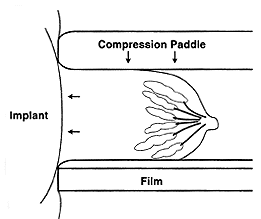
In these additional x-ray pictures, called Eklund views or implant displacement (ID)
views, the implant is pushed back against the chest wall and the breast is pulled forward
over it. This allows better imaging of the forward most part of each breast. The implant
displacement views are not as successful in women who have contractures (formation of hard scar tissue
around the implants). The ID views are easiest to obtain in a women whose implants are
placed underneath (behind) the chest muscle.
 |
 |
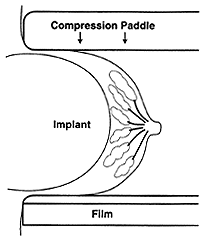
Standard mammography
views are taken first.
The breast and implant are compressed
with moderate force |
Image displacement
mammography views (also called Eklund views) are performed with the implant pushed back
against the chest wall. The compression paddle is applied to the breast tissue, which is
pulled forward. |
Mammography Guidelines for
Following Breast Reduction Surgery
Women who have had breast contouring or
breast reduction (also called mastopexy or reduction
mammaplasty) should also receive annual mammograms once they reach 40 years of age. It is
important for the radiologist to be aware of the patient's surgical history. This will
help the radiologist when they interpret the mammogram images.
Magnetic Resonance (MR) Imaging
of Breast Implants
Magnetic
Resonance (MR) imaging of the breasts (also called MR Mammographyor Breast MR1) can be
used to image breast implants to check for ruptures or leaks. MR imaging may also be used
as an adjunctive tool to conventional mammography for women with implants.
MR imaging gives radiologists
significant freedom in acquiring direct views of the breasts in any plane or orientation.
This is because the MR system switches magnetic fields and radio waves to achieve the
acquisition of different views while x-ray mammography requires re-orientation of the
breast and mammography system for each view desired. MR also allows the doctors to easily
visualize the muscle and chest wall in the vicinity of the breast, which may be important
to check for the spread of cancer.
MR imaging can also be used to image
breast tissue and cosmetic implants. Implants can obscure some of the breast tissue on
conventional x-ray mammography images. This is because x-rays used for mammographic
imaging of the breasts cannot penetrate silicone or saline implants well enough to image
the overlying or underlying breast tissue. MR imaging does not have this limitation.
MR mammography can image the breast
tissue that is compressed by an implant. However, x-ray mammography is still the best tool
for evaluating breast tissue and for screening and diagnosing breast cancer. MR
mammography requires intravenous contrast (gadolinium),
is much more expensive than conventional mammography and has limitations in sensitivity
and specificity. There is no routine recommendation for using MR imaging as a cancer
screening tool in women with implants, although it can be helpful in selected cases.
Magnetic resonance is the imaging
method of choice to evaluate breast implants and to check for ruptures or leaks. MR
imaging provides very good spatial resolution (detail) and excellent contrast resolution
and enables MR to clearly visualize implant condition.

Transverse high-resolution MR
mammography of breast and implants.
Note the implant twisting on the upper (left) image and the implant valve on the lower
(left) image
Ultrasound Imaging of Breast Implants
Breast ultrasound
may also be used as a screening tool for the detection of implant rupture or leak.
However, the sensitivity and specificity of ultrasound is lower than magnetic resonance
imaging since ultrasound typically provides lower spatial resolution and less contrast
resolution than MR. Ultrasound imaging is usually less expensive than MR imaging. MR
imaging can also be more time consuming than ultrasound. Some patients may also prefer
ultrasound over MR imaging, which some find to cause claustrophobia and mild anxiety.
Breast
Biopsy for Women with Implants
Vacuum-assisted
biopsy (brand names, Mammotome or MIBB) allows physicians to perform accurate breast
biopsies on women with breast implants. Prior to the advent of vacuum-assisted biopsy,
women with implants typically had to undergo open surgical
biopsy if breast cancer was suspected.
Unlike surgical biopsy, vacuum-assisted
biopsy is a percutaneous ("through the skin") procedure. Vacuum-assisted biopsy
relies on stereotactic mammography
or ultrasound imaging for guidance.
Stereotactic mammography involves using computers to pinpoint the exact location of a
breast mass based on mammograms (x-rays) taken from two different angles. The computer
coordinates will help the physician to guide the needle to the correct area in the breast.
With ultrasound, the radiologist or surgeon will watch the needle on the ultrasound
monitor to help guide it to the area of concern.
The precision and directional abilities
of vacuum-assisted biopsy make it the most viable percutaenous ("through the
skin") biopsy option for women with breast implants. Conventional core needle biopsy is typically less precise in locating breast
abnormalities (lesions) and requires multiple needle insertions in order to obtain
adequate breast tissue samples. Due to these limitations, core needle biopsy has been
problematic in the past for women with breast implants.
Vacuum-assisted breast biopsy provides
a safer approach for women with implants. Unlike core needle biopsy, the vacuum-assisted
biopsy probe is inserted just once into the breast through a small nick in the skin.
Multiple tissue samples may be taken by rotating the sampling needle aperture (opening)
and using vacuum assistance. The placement of the vacuum-assisted biopsy needle is
carefully manually positioned between the implant and breast abnormality (lesion).
Click here to
learn more about breast biopsy.
Updated: July 2006
Return to Breast Health
Main Menu |